
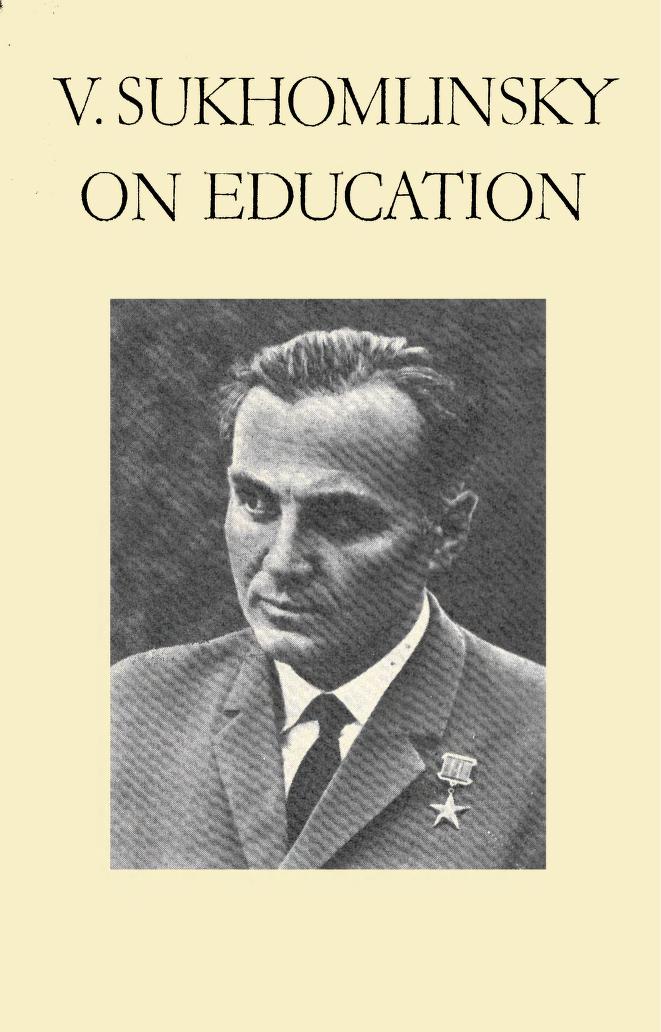
Vasily Alexandrovich Sukhomlinsky, distinguished Soviet educationist, scholar, and Hero of Socialist Labour, is widely known in the USSR and abroad. Director of a village school in the Ukraine from 1944 until his death on September 2, 1970, Sukhomlinsky devoted the whole of his active life to the noble cause of child education.
He left a considerable body of written works. The foreign reader is already familiar with his books I Give My Heart to Children and The Birth of a Citizen. V. Sukhomlinsky on Education is an unusual compilation, containing selected passages from many of his writings, including some of those hitherto unpublished. The foreword by S. Soloveichik, a journalist who has devoted many years to educational problems, gives a lively and interesting account of Sukhomlinsky and of the reflections, searchings, discoveries, aspirations and dreams of this remarkable man.
What is the best way of encouraging children to take an interest in knowledge, of teaching them to be happy in their work, and of awakening and developing an understanding of beauty and the desire to become real human beings and citizens of their native country?
Teachers, parents and all concerned with the problems of education will find in this book the practical advice and interesting reflections of a talented educationist.
Translated from the Russian by Katharine Judelson
Designed by Vladimir Dober
All credits to Guptaji
You can get the book here and here
Follow us on
Twitter https://x.com/MirTitles
Mastadon https://mastodon.social/@mirtitles
Bluesky https://bsky.app/profile/mirtitles.bsky.social
Tumblr https://www.tumblr.com/mirtitles
Internet Archive https://archive.org/details/mir-titles
Fork us on gitlab https://gitlab.com/mirtitles
CONTENTS
SUKHOMLINSKY’S PARADOX 5
I. EDUCATION AND THE EDUCATOR 50
I Am a Firm Believer in the Great Power of Education 50
The Need to Understand the Workings of the Child’s Heart 62
Fostering a Sense of Involvement in Work 70
One of the Most Difficult Tests for the Teacher 80
We Try to Make Even the Walls of the School Speak to the Children 98
Half Our Work Is Devoted to Health Care 110
Teaching Must Become a Science for Everyone 120
II. STUDY 126
Knowledge Is Vital to Man, Precisely Because He Is Human 126
All Our Plans Are Reduced to Naught, if Our Pupils Have No Desire to Learn 130
Children Should Live in a World of Creativity 144
A True School Is a Kingdom of Active Thought 164
To Give Pupils a Spark of Knowledge, the Teacher Must Imbibe a Whole Sea of Light 173
III. WORK 188
Love of Work Is Essential for the Development of Our Characters and Intellectual Ability 188
Joy from Work which Enhances Everyday Life 194
From Technical ABC’s to Advanced Working Skills 207
IV. BEAUTY 219
To the Humane by Way of the Beautiful 219
The Fairy-Tale Cannot Exist Without Beauty 232
Music Keeps the Heart Straight 242
School Means First and Foremost Books 248
Looking at Pictures Is an Introduction to the World of Feelings 258
V. THE COLLECTIVE 265
Rallying Pupils Together 265
The Collective: an Infinitely Complex Sphere of Emotional and Cultural Interaction 273
What Can Be Expected of a Children’s Collective? 281
VI. MORALS AND CONVICTIONS 287
Man’s Sacred Duty 287
Devotion to an Ideal Is Impossible Unless Man Feels a Deep Need for His Fellows 293
Compatibility of Convictions and Actions 309
The World of Ideas Unfolds to Children after They Enter Their Teens 319
Nothing in This World Is More Interesting Than Man Himself 337
Guidance in Self-Education 343
SOURCES 347


