
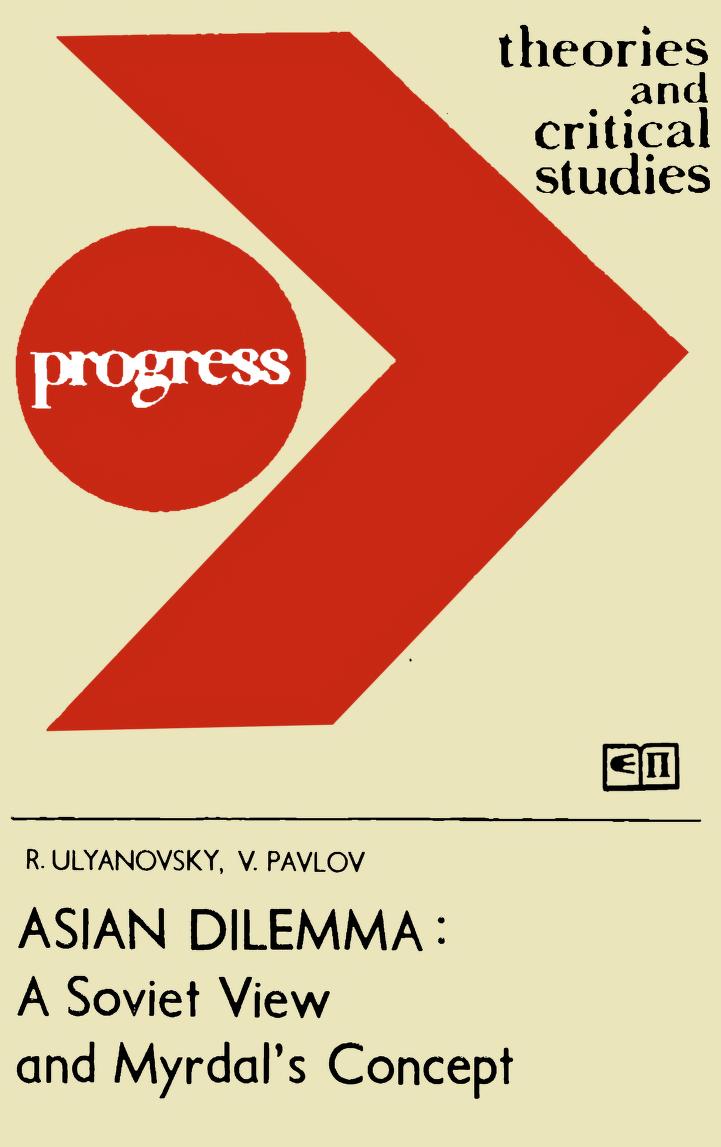
Asian Dilemma – A Soviet View and Myrdal’s Concept by R. Ulyanovsky and V. Pavlov critically examines the socio-economic development and industrialization strategies in Asia from a Soviet perspective. The book engages with Gunnar Myrdal’s “alternative, institutional theory,” challenging his methods and conclusions about the multi-structural nature of Asian societies and the impact of foreign capital. It emphasizes the importance of comprehensive socio-economic transformation and state intervention to overcome stagnation and underdevelopment, arguing for the adoption of socialist principles as a solution to the region’s challenges. This Soviet critique underscores the ideological clash between Western and Soviet approaches to economic development and social progress in the Third World.
Translated from the Russian by Leo Lempert
Edited by Robert Daglish and Leonid Kolesnikov
You can get the book here and here
CONTENTS
1. A Few Words About Professor Myrdal 7
2. Professor Myrdal’s “Unbiased” Approach and His “Alternative, Institutional Theory” 10
3. Recognition of the Multi-Structural Nature of Society as a Methodological Basis of Research 15
4. Distribution System as a Derivative of the Mode of Production and Its Indicator 19
5. Awareness of Social Being in Conditions of Multi-Structural Societies 24
6. Essence of Stagnation, Underdevelopment and Need to Develop 28
7. The “Institutional Concept” and the Doctrine of Industrialisation 41
8. Importance of a Comprehensive Study and All-Round Transformation of the Third World 47
9. Relationship of the Universal and the Particular in the Evolution of South Asia 50
10. Objective Truth and Subjective Evaluations 55
11. The Theory and Practice of the Two Ways of Development 80
12. State Regulation of the Economy. Its Aims and Possibilities— the Example of India 90
13. Some Theoretical and Practical Aspects of State-Capitalist Regulation 99
14. Elimination of Backwardness—in the Name of the People and for the People 118
15. The Democratic Essence of State Intervention in Socio-Economic Processes 124
16. Positions of Foreign Capital 133
17. The Socialist Community and the Third World 137
18. The Non-Capitalist Path as an Historical Reality 152

 Mir Books