
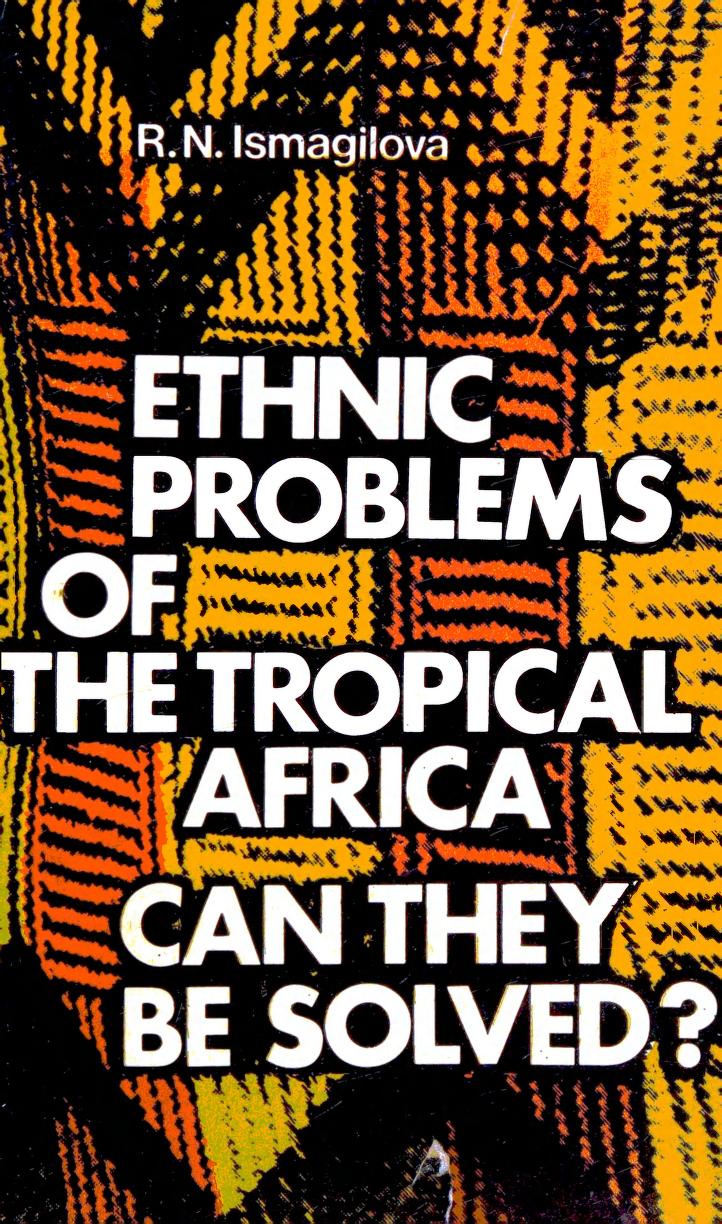
Dr. Ismagilova’s book on the ethnic problems of Tropical Africa is the first monograph in Marxist African studies to extensively cover these issues in this region. The author utilizes a wealth of diverse source materials and literature in various languages, along with her personal observations in seventeen African countries. The book’s value lies in its ability to highlight and differentiate the general and specific aspects of the complex ethnic evolution of Tropical Africa, demonstrating the applicability of general laws and patterns of social and ethnic development in African conditions.
Dr. Ismagilova discusses the role of the ethnic factor in contemporary Tropical Africa, its impact on political life, and the efforts of governments to implement social and economic measures. She reveals the social roots and nature of ethnic contradictions and antagonisms in this area, discusses the principles set out in African government and party programs for addressing national issues, and describes the steps taken by several governments in this regard.
Additionally, Dr. Ismagilova examines the special nature of ethnic processes and national integration in Africa, emphasizing the close link between ethnic problems and social and economic reform programs. She outlines possible methods for addressing the ethnic problems of Tropical Africa, dedicating a special chapter to the approaches used in the Soviet Union. Dr. Ismagilova believes that the ethnic problems in Tropical Africa can be resolved through consistent and profound social reforms, acknowledging that this will be a lengthy process of social evolution, not easily addressed through administrative solutions, and ultimately requiring a profound transformation of African society.
Dr. Roza Ismagilova: A Leading Soviet Africanist
Dr. Roza Ismagilova, a leading Soviet Africanist with over twenty-five years of experience in the history and social anthropology of Africa, was born in Tomsk, Siberia, to a Tatar geologist. Educated in Kazakhstan and Uzbekistan, she observed the national policies of the Communist Party of the Soviet Union. After graduating in history from Central Asian University in Tashkent, she pursued postgraduate studies at the Institute of Ethnography of the USSR Academy of Sciences in Moscow, earning her Candidate’s degree in 1955 and her doctorate in history in 1971. Dr. Ismagilova worked at the Institute of Ethnography until 1960, when she joined the newly founded Africa Institute of the Academy, where she has been a staff member since its inception.
A skilled linguist, Dr. Ismagilova speaks Tatar and Russian (her mother tongue), and has studied Kazakh, Uzbek, German, French, English, Portuguese, and Swahili. She has visited seventeen African countries, conducting on-site studies of ethnic problems, and has participated in numerous international conferences, symposia, and seminars. An editor of several scientific publications, her own works (in Russian) include The Peoples of Kenya under the Colonial Regime (1956), The Peoples of Nigeria. Ethnic Composition and Brief Ethnographic Description (1963), and Ethnic Problems of Contemporary Tropical Africa (1973).
Translated from the Russian by A.N. Uthernitt
Designed by D. Anikeev
Credits to the original uploaders, this is a cleaned optimised scan.
You can get the book here and here
Contents
Introduction
Page 7
Chapter One: Forms of National Oppression under the Colonial Regime
Page 22
Chapter Two: Effect of the Ethnic Factor in Consolidating National Independence and Socio-Economic Development
Page 43
Chapter Three: The Nature and Roots of Ethnic Tensions and Conflicts
Page 79
Chapter Four: Ways and Methods of Dealing with Ethnic Problems
Page 99
1. Principles for Dealing with Ethnic Problems in Government and Party Programmes
Page 100
2. The Tackling of Ethnic Problems in Practice
Page 135
Chapter Five: Difficulties in Dealing with Ethnic Problems
Page 184
1. Discrepancies between Ethnic and Political Boundaries
Page 184
2. Self-Determination and Separatism
Page 191
Chapter Six: The Interaction of National and Social Factors
Page 199
Chapter Seven: Is It Possible to Live without Ethnic Conflicts?
Page 241
Conclusion
Page 260
References and Selected Bibliography
Page 271
Geographical Index
Page 294
Ethnic Index
Page 298
Name Index
Page 301

 Mir Books