
In this post we will see the two volume set titled Fundamentals of Theoretical Physics by I. V. Savelyev. Previously we have seen Physics A General Course by the same author.
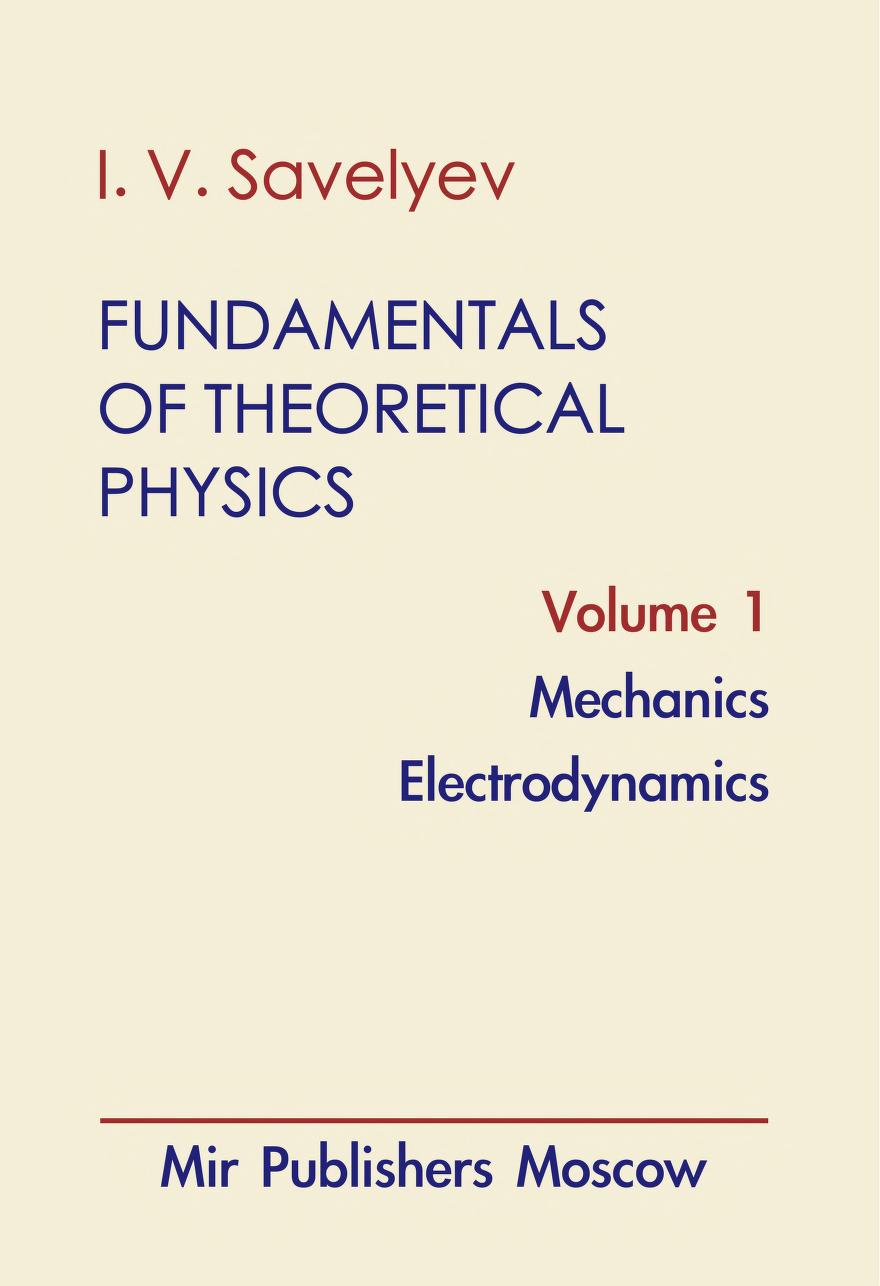

The book being offered to the reader is a logical continuation of the author’s three-volume general course of physics. Everything possible has been done to avoid repenting what has been set out in the three-volume course. Particularly. the experiments underlying the advancing of physical ideas are not treated, and some of the results obtained are not discussed.
The book has been conceived as a training aid for students of non- theoretical specialities of higher educational institutions. I had in mind readers who would like to grasp the main ideas and methods of theoretical physics without delving into the details that are of interest only for a specialist. This book will be helpful for physics instructors at higher schools, and also for everyone interested in the subject but having no time to become acquainted with it (or re- store it in his memory) according to fundamental manuals.
The books were translated from the Russian by G. Leib and was first published in 1982.
We have added new covers to existing pdfs. All other credits to original uploaders. Thanks to commentators for points the libgen links.
Fundamentals of Theoretical Physics Vol 1 and here
Fundamentals of Theoretical Physics Vol 2 and here
Contents of Volume 1
Part One: Mechanics
Chapter I. The Variational Principle in Mechanics
1. Introduction – 11
2. Constraints – 13
3. Equations of Motion in Cartesian Coordinates – 16
4. Lagrange’s Equations in Generalized Coordinates – 19
5. The Lagrangian and Energy – 24
6. Examples of Compiling Lagrange’s Equations – 28
7. Principle of Least Action – 33
Chapter II. Conservation Laws
8. Energy Conservation – 36
9. Momentum Conservation – 37
10. Angular Momentum Conservation – 39
Chapter III. Selected Problems in Mechanics
11. Motion of a Particle in a Central Force Field – 41
12. Two-Body Problem – 45
13. Elastic Collisions of Particles – 49
14. Particle Scattering – 53
15. Motion in Non-Inertial Reference Frames – 57
Chapter IV. Small-Amplitude Oscillations
16. Free Oscillations of a System Without Friction – 64
17. Damped Oscillations – 66
18. Forced Oscillations – 70
19. Oscillations of a System with Many Degrees of Freedom – 72
20. Coupled Pendulums – 77
Chapter V. Mechanics of a Rigid Body
21. Kinematics of a Rigid Body – 82
22. The Euler Angles – 85
23. The Inertia Tensor – 88
24. Angular Momentum of a Rigid Body – 95
25. Free Axes of Rotation – 99
26. Equation of Motion of a Rigid Body – 101
27. Euler’s Equations – 105
28. Free Symmetric Top – 107
29. Symmetric Top in a Homogeneous Gravitational Field – 111
Chapter VI. Canonical Equations
30. Hamilton’s Equations – 115
31. Poisson Brackets – 119
32. The Hamilton-Jacobi Equation – 121
Chapter VII. The Special Theory of Relativity
33. The Principle of Relativity – 125
34. Interval – 127
35. Lorentz Transformations – 130
36. Four-Dimensional Velocity and Acceleration – 134
37. Relativistic Dynamics – 136
38. Momentum and Energy of a Particle – 139
39. Action for a Relativistic Particle – 143
40. Energy-Momentum Tensor – 147
Part Two: Electrodynamics
Chapter VIII. Electrostatics
41. Electrostatic Field in a Vacuum – 157
42. Poisson’s Equation – 159
43. Expansion of a Field in Multipoles – 161
44. Field in Dielectrics – 166
45. Description of the Field in Dielectrics – 170
46. Field in Anisotropic Dielectrics – 175
Chapter IX. Magnetostatics
47. Stationary Magnetic Field in a Vacuum – 177
48. Poisson’s Equation for the Vector Potential – 179
49. Field of Solenoid – 182
50. The Biot-Savart Law – 186
51. Magnetic Moment – 188
52. Field in Magnetics – 194
Chapter X. Time-Varying Electromagnetic Field
53. Law of Electromagnetic Induction – 199
54. Displacement Current – 200
55. Maxwell’s Equations – 201
56. Potentials of Electromagnetic Field – 203
57. D’Alembert’s Equation – 207
58. Density and Flux of Electromagnetic Field Energy – 208
59. Momentum of Electromagnetic Field – 211
Chapter XI. Equations of Electrodynamics in the Four-Dimensional Form
60. Four-Potential – 216
61. Electromagnetic Field Tensor – 219
62. Field Transformation Formulas – 222
63. Field Invariants – 225
64. Maxwell’s Equations in the Four-Dimensional Form – 228
65. Equation of Motion of a Particle in a Field – 230
Chapter XII. The Variational Principle in Electrodynamics
66. Action for a Charged Particle in an Electromagnetic Field – 232
67. Action for an Electromagnetic Field – 234
68. Derivation of Maxwell’s Equations from the Principle of Least Action – 237
69. Energy-Momentum Tensor of an Electromagnetic Field – 239
70. A Charged Particle in an Electromagnetic Field – 244
Chapter XIII. Electromagnetic Waves
71. The Wave Equation – 248
72. A Plane Electromagnetic Wave in a Homogeneous and Isotropic Medium – 250
73. A Monochromatic Plane Wave – 255
74. A Plane Monochromatic Wave in a Conducting Medium – 260
75. Non-Monochromatic Waves – 265
Chapter XIV. Radiation of Electromagnetic Waves
76. Retarded Potentials – 269
77. Field of a Uniformly Moving Charge – 272
78. Field of an Arbitrarily Moving Charge – 276
79. Field Produced by a System of Charges at Great Distances – 288
80. Dipole Radiation – 288
81. Magnetic Dipole and Quadrupole Radiations – 291
Appendices
I. Lagrange’s Equations for a Holonomic System with Ideal Non-Stationary Constraints – 297
II. Euler’s Theorem for Homogeneous Functions – 299
III. Some Information from the Calculus of Variations – 300
IV. Conics – 309
V. Linear Differential Equations with Constant Coefficients – 313
VI. Vectors – 316
VII. Matrices – 330
VIII. Determinants – 338
IX. Quadratic Forms – 347
X. Tensors – 355
XI. Basic Concepts of Vector Analysis – 370
XII. Four-Dimensional Vectors and Tensors in Space – 393
XIII. The Dirac Delta Function – 412
XIV. The Fourier Series and Integral – 413
Index – 419
Contents of Volume 2
Chapter I. Foundations of Quantum Mechanics
1. Introduction – 9
2. State – 10
3. The Superposition Principle – 12
4. The Physical Meaning of the Psi-Function – 14
5. The Schrödinger Equation – 16
6. Probability Flux Density – 20
Chapter II. Mathematical Tools of Quantum Mechanics
7. Fundamental Postulates – 23
8. Linear Operators – 27
9. Matrix Representation of Operators – 31
10. The Algebra of Operators – 38
11. The Uncertainty Relation – 45
12. The Continuous Spectrum – 48
13. Dirac Notation – 51
14. Transformation of Functions and Operators from One Representation to Another – 55
Chapter III. Eigenvalues and Eigenfunctions of Physical Quantities
15. Operators of Physical Quantities – 63
16. Rules for Commutation of Operators of Physical Quantities – 67
17. Eigenfunctions of the Coordinate and Momentum Operators – 71
18. Momentum and Energy Representations – 74
19. Eigenvalues and Eigenfunctions of the Angular Momentum Operator – 78
20. Parity – 81
Chapter IV. Time Dependence of Physical Quantities
21. The Time Derivative of an Operator – 83
22. Time Dependence of Matrix Elements – 86
Chapter V. Motion of a Particle in Force Fields
23. A Particle in a Central Force Field – 89
24. An Electron in a Coulomb Field: The Hydrogen Atom – 94
25. The Harmonic Oscillator – 106
26. Solution of the Harmonic Oscillator Problem in the Matrix Form – 109
27. Annihilation and Creation Operators – 116
Chapter VI. Perturbation Theory
28. Introduction – 123
29. Time-Independent Perturbations – 123
30. Case of Two Close Levels – 132
31. Degenerate Case – 136
32. Examples of Application of the Stationary Perturbation Theory – 141
33. Time-Dependent Perturbations – 148
34. Perturbations Varying Harmonically with Time – 156
35. Transitions in a Continuous Spectrum – 163
36. Potential Energy as a Perturbation – 164
Chapter VII. The Quasiclassical Approximation
37. The Classical Limit – 169
38. Boundary Conditions at a Turning Point – 174
39. Bohr-Sommerfeld Quantization Rule – 184
40. Penetration of a Potential Barrier – 188
Chapter VIII. Semiempirical Theory of Particles with Spin
41. Psi-Function of a Particle with Spin – 192
42. Spin Operators – 194
43. Eigenvalues and Eigenfunctions of Spin Operators – 202
44. Spinors – 205
Chapter IX. Systems Consisting of Identical Particles
45. Principle of Indistinguishability of Identical Particles – 214
46. Psi-Functions for Systems of Particles: The Pauli Principle – 216
47. Summation of Angular Momenta – 222
48. Psi-Function of a System of Two Particles Having a Spin of 1/2 – 225
49. Exchange Interaction – 229
50. Second Quantization – 233
51. Second Quantization Applied to Bosons – 235
52. Second Quantization Applied to Fermions – 250
Chapter X. Atoms and Molecules
53. Methods of Calculating Atomic Systems – 258
54. The Helium Atom – 259
55. The Variation Method – 263
56. The Method of the Self-Consistent Field – 268
57. The Thomas-Fermi Method – 275
58. The Zeeman Effect – 278
59. The Theory of Molecules in the Adiabatic Approximation – 281
60. The Hydrogen Molecule – 285
Chapter XI. Radiation Theory
61. Quantization of an Electromagnetic Field – 291
62. Interaction of an Electromagnetic Field with a Charged Particle – 301
63. One-Photon Processes – 305
64. Dipole Radiation – 308
65. Selection Rules – 312
Chapter XII. Scattering Theory
66. Scattering Cross Section – 315
67. Scattering Amplitude – 317
68. Born Approximation – 319
69. Method of Partial Waves – 321
70. Inelastic Scattering – 328
Appendices
I. Angular Momentum Operators in Spherical Coordinates
II. Spherical Functions
III. Chebyshev-Hermite Polynomials
IV. Some Information from the Theory of Functions of a Complex Variable
V. Airy Function
VI. Method of Green’s Functions
VII. Solution of the Fundamental Equation of the Scattering Theory by the Method of Green’s Functions
VIII. The Dirac Delta Function

 Mir Books
Hello my friends. How can I buy Mir books on mathematics and physics. I neede some 10 or 12 books. Please let me know.
Assar
LikeLike
You can check old book shops if you are in India. Otherwise there are still some sites which sell them though at a much higher price
LikeLike
You can contact amishra1994@rediffmail.com
LikeLike
Thanks a million! 🙂
Regards,
LikeLike
Excellent books! I studied physics, but this set in its own has summed all my physics knowledge up in an exact manner. Thanks for all sharings.
LikeLike
I have a question will u help me please ?
LikeLike
I have few copies of irodov for sale,anyone interested
LikeLike
I am interested
LikeLike
Do you know because in these great books there aren’t Thermodynamics ans Statistical mechanics?
LikeLike
Can you please make “Physics a refresher course – Yavorksy” and “Algebra and analysis of elementary functions – Popatov” priority posts? I can’t find the former anywhere and the latter is overpriced.
LikeLike
Hey guys!
Thank you so much for all your effort and great job.
About “Fundamentals of Theoretical Physics – Savelyev”, I would just like to let you know that pages 176 and 177 of volume 2 are missing. Please add them!
Thanks again.
LikeLike