Mécanique Rationnelle par N. Tchétaev

Dans cet article, nous verrons le livre Mécanique Rationnelle par N. Tchétaev.

À propos du livre

Ce cours de Mécanique Rationnelle a été conçu pour les étudiants des
Universités de Kazan’ et de Moscou. La conception de ce cours a été marquée par les idées des professeurs D. Seiliger et V. Steklov qui m’ont prodigué leurs conseils et m’ont inculqué la maxime « Mieux vaut moins mais de meilleure qualité ».
Les cours de Mécanique Rationnelle existent depuis longtemps. On les
doit à Lagrange, Euler, Poinsot et Joukovski. Il m’a donc semblé raisonnable de répéter certains développements qui ont été élaborés par ces savants et qui me paraissaient excellents, plutôt que de rechercher à tout prix l’originalité en sacrifiant ce qui a été bien fait par quelqu’un d’autre.
Je me suis efforcé de rendre clair l’exposé des problèmes de Mécanique
Rationnelle. En cinématique j’ai pris soin d’éviter l’emploi des coordonnées obliques et curvilignes puisqu’on établit facilement les équations de la dynamique en coordonnées curvilignes à l’aide des équations de Lagrange. Aux équations de Lagrange qui sont insensibles aux coordonnées covariantes et contravariantes sont liés, selon Cartan, les éléments de l’analyse
tensorielle.

Le livre a été traduit du russe par S. Medvédev.
L’édition française a été publiée en 1993 par les éditions Mir.

Un grand merci à Henri Leveque pour le scan original.
Vous pouvez obtenir le livre ici.

(J’ai utilisé la traduction automatique, toutes mes excuses pour les erreurs.)
Suivez-nous sur Internet Archive: https://archive.org/details/@mirtitles
Suivez-Nous Sur Twitter: https://twitter.com/MirTitles
Écrivez-nous: mirtitles@gmail.com
Rejoignez-nous sur GitLab: https://gitlab.com/mirtitles/
Ajoutez de nouvelles entrées au catalogue


Posted in Éditions Mir, books | Tagged , , , , , , , | Leave a comment

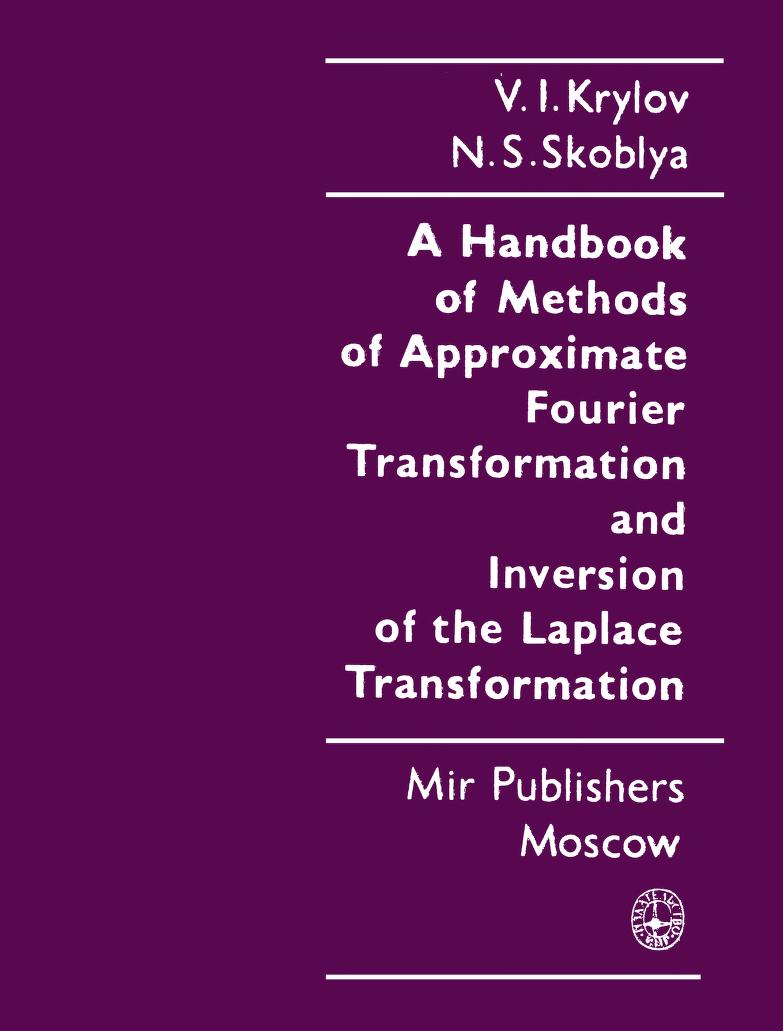
A Handbook Of Methods Of Approximate Fourier Transformation And Inversion Of The Laplace Transformation by V. I. Krylov; N. S. Skoblya

In this post, we will see the book A Handbook Of Methods Of Approximate Fourier Transformation And Inversion Of The Laplace Transformation by V. I. Krylov; N. S. Skoblya.

About the book

Harmonic analysis and the Laplace transformation are tools that are frequently used to solve a wide range of theoretical and applied problems. This text, contains most of the familiar methods of approximate inversion of the Laplace transformation and calculation of Fourier integrals. This book is designed for scientists and engineers that have to deal with the theory and applications of the Laplace transform and Fourier integrals. It will be a useful handbook in every computer centre and designing bureau.
 This text is aimed at a broad category of readers engaged in the theory of the Laplace transformation or its scientific and technical applications. For this reason, the authors did not strive for particular brevity in presentation and attempt­ ed to make the text accessible to nonmathematicians as well. It is assumed the reader has a basic knowledge of analysis and the theory of functions of a complex variable as given in any extended college course of mathematics.


Many thanks to @hawakajhonka for making the books available.

Translated from the Russian by George Yankovsky

First published 1977

Revised from the 1974 Russian edition

Published by Mir Publishers.

You can get the book here.

Follow us on The Internet Archive: https://archive.org/details/@mirtitles
Follow Us On Twitter: https://twitter.com/MirTitles
Write to us: mirtitles@gmail.com
Fork us at GitLab: https://gitlab.com/mirtitles/
Add new entries to the detailed book catalog here.

Contents


List of symbols 8

Preface 9

Part One

INVERSION OF THE LAPLACE TRANSFORMATION


Chapter 1. Introduction

1.1 Basic concepts in the theory of the Laplace transformation 15

1.2 Complex integral for computing inverse Laplace trans­forms 22

1.3 Representing functions by the Laplace integral 25

1.4 Ill-conditioning of the problem of computing inverse Laplace transforms 30


Chapter 2. Some Analytical Methods for Computing Inverse Laplace Transforms


2.1 Finding the original function via the inversion formula 32

2.2 Expanding the original function into power series 36

2.3 Expanding the original function into generalized power series 38


Chapter 3. Methods of Numerical Inversion of Laplace Transforms Based on the Use of Special Expansions


3.1 Computing inverse Laplace transforms by polynomials or­thogonal on a finite interval 41

3.2 Computing inverse Laplace transforms with the aid of the Fourier sine series 67

3.3 Computing inverse Laplace transforms with the aid

of series in terms of generalized Chebyshev-Laguerre po­lynomials 70


Chapter 4. Methods of Computing the Mellin Integral with the Aid of Interpolation Quadrature Formulas


4.1 The general theory of interpolation methods 75

4.2 The equal-interval interpolation method 79

4.3 The unequal-interval interpolation method 80

4.4 Other interpolation methods. Using the truncated Tay­lor series 90

4.5 Some theorems on convergence of interpolation . 92

4.6 Theorems on the convergence of interpolation methods of inversion 105


Chapter 5. Methods of Numerical Inversion of Laplace Trans­ forms via Quadrature Formulas of Highest Accuracy


5.1 The theory of quadrature formulas 110

5.2 Orthogonal polynomials connected with the quadrature formula of highest accuracy 118

5.3 Methods for computing the coefficients and points of a quadrature formula 136


Chapter 6. Methods of Inverting Laplace Transforms via Quad­rature Formulas with Equal Coefficients


6.1 Constructing a computation formula 145

6.2 Remark on the spacing of points 148


Part Two

FOURIER TRANSFORMS AND THEIR APPLICATION TO INVERSION OF LAPLACE TRANSFORMS


Chapter 7. Introduction


7.1 Fourier transforms 150

7.2 Reducing integrals of the Mellin type to the Fourier transformation 157


Chapter 8. Inversion of Laplace Transforms by Means of the Fourier Series


8.1 The case of a rapidly decreasing original function / (x) 159

8.2 The case of rapid decrease of the modulus of the image function F (p) 161


Chapter 9.Interpolation Formulas for Computing Fourier Integ­rals


9.1 Some preliminary remarks 164

9.2 Algebraic interpolation of the function f (x) 166

9.3. Interpolation by rational functions 201


Chapter 10. Highest-Accuracy Formulas for Computation


10.1 Introduction 233

10.2 Constructing a formula of highest degree of accuracy 236


Part Three

ISOLATING SINGULARITIES OF A FUNCTION IN COMPUTATIONS


Chapter 11. Isolating Singularities of the Image Function F (p)


11.1 Introduction 245

11.2  Removing and weakening the singularities of the image function F (p) 247

11.3 A remark on the increase in the rate of approach to zero of the image function F ( p ) 252

11.4 A table of image functions F (p) and the corresponding original functions / (x) for constructing the singular part of the image function Fx(p) 254


Chapter 12. Isolating Singularities of a Function in the Fourier Transformation


12.1 Removing discontinuities of the first kind 259

12.2 Increasing the rate of approach to zero of the function undergoing transformation 263


Bibliography 266

Index 268


Posted in books, mathematics | Tagged , , , , , , , , , , | 1 Comment

Biophysique par M. Volkenstein

Dans cet article, nous verrons le livre Biophysique par M. Volkenstein.

À propos du livre

Ce livre est destiné aux étudiants, ainsi qu’à ceux qui ont déjà
terminé l’Université : aux biologistes et aux physiciens étudiant la
biophysique. Il est issu du cours, dont l’auteur est chargé depuis bien
des années à l’Institut physico-technique de Moscou, et de deux monographies
parues antérieurement. La première de ces monographies,
« Biophysique moléculaire », a été éditée en russe (1975) et en anglais
(Academie Press, 1977). La seconde, «Biophysique générale», est
également parue en deux langues: la version russe en 1978 et la traduction
anglaise en 1983 (également chez Academie Press). Le texte
du présent livre est nouveau. Par ailleurs, les deux monographies
précitées sont recommandées à ceux qui aimeraient approfondir leurs
connaissances. On y trouve une abondante bibliographie.
A mon avis, la biophysique n’est pas une branche accessoire de
la biologie, mais une partie légitime de la physique : c’est la physique
de la Nature vivante. Voilà pourquoi j’ai tenu à faire la distinction
entre la biophysique et la physiologie, bien que ces deux disciplines
possèdent beaucoup de points communs. Le livre est essentiellement
consacré aux problèmes théoriques de la biophysique, mais les faits
expérimentaux les plus importants y ont trouvé leur place.
La présente édition comporte des suppléments et des modifications
par rapport aux versions russe et anglaise parues auparavant ;
il y a, notamment, deux nouveaux paragraphes relatifs à la topologie
des ADN et à la réception acoustique.
Je me rends parfaitement compte des difficultés que rencontre
un auteur qui veut écrire un cours encyclopédique de biophysique.

La biophysique d’aujourd’hui est un domaine des sciences naturelles
très vaste, complexe et varié; un spécialiste ne peut connaître également
bien tous ses problèmes. Cela se traduit inévitablement par
certains défauts de l’exposé. Je serais donc reconnaissant aux lecteurs
de toutes leurs suggestions et critiques.

Le livre a été traduit du russe par Eugène Oumanski.
L’édition française a été publiée en 1985 par les éditions Mir.

Un grand merci à Henri Leveque pour le scan original.
Vous pouvez obtenir le livre ici.

(J’ai utilisé la traduction automatique, toutes mes excuses pour les erreurs.)
Suivez-nous sur Internet Archive: https://archive.org/details/@mirtitles
Suivez-Nous Sur Twitter: https://twitter.com/MirTitles
Écrivez-nous: mirtitles@gmail.com
Rejoignez-nous sur GitLab: https://gitlab.com/mirtitles/
Ajoutez de nouvelles entrées au catalogue


Posted in books | Tagged , , , , , , , , , , , , , | Leave a comment

Problèmes Mathématiques D’ Analyse Des Systèmes par N. Moïsseev

Dans cet article, nous verrons le livre Problèmes Mathématiques D’ Analyse Des Systèmes par N. Moïsseev.

À propos du livre

La discipline qui a pour nom « analyse des systèmes » est née des
besoins de procéder à des études de caractère interdisciplinaire. La
conception de systèmes techniques compliqués, la planification et la
gestion de complexes économiques, l’analyse des situations écologiques
et nombre d’autres orientations des activités technique,
scientifique et économique ont nécessité une organisation des recherches
qui rompît avec la tradition : concentration des efforts des scientifiques
de diverses branches, unification et concordance de l’information
recueillie par des recherches concrètes. Ces recherches interdisciplinaires,
appelées parfois recherches complexes ou de systèmes,
doivent leur succès pour une grande part aux possibilités de
traitement de l’information, à la mise en oeuvre de méthodes mathématiques
qui ont vu le jour avec les ordinateurs, méthodes qui ont
fourni non seulement un instrument, mais aussi un langage éminemment
universel. Soulignons encore une fois que l’analyse des systèmes
est née à l’époque des ordinateurs, et son essor dépend pour beaucoup
de leurs performances actuelles et futures. Pour cette raison,
le vocable « analyse des systèmes » sera pris dans cet ouvrage dans
une acception assez étroite: par analyse des systèmes on entendra Vensemble
des méthodes s’appuyant sur les ordinateurs et ayant pour objet
Vétude de systèmes: techniques, économiques, écologiques, etc. Le résultat
de ces recherches sera en principe constitué par la prise d’une
décision: un plan de développement d’une région, des paramètres
de construction, etc. Donc, Vanalyse des systèmes est une discipline
qui s’intéresse aux problèmes décisionnels lorsque la prise d’une décision
implique une analyse d’une information complexe de diverse nature physique.
Par conséquent, l’analyse des systèmes et ses conceptions méthodologiques
tiennent des disciplines qui s’occupent des problèmes
décisionnels: la théorie de la recherche opérationnelle et la théorie
générale de la commande.

Le livre a été traduit du russe par Djilali Embarek.
L’édition française a été publiée en 1985 par les éditions Mir.

Un grand merci à Henri Leveque pour le scan original.
Vous pouvez obtenir le livre ici.

(J’ai utilisé la traduction automatique, toutes mes excuses pour les erreurs.)
Suivez-nous sur Internet Archive: https://archive.org/details/@mirtitles
Suivez-Nous Sur Twitter: https://twitter.com/MirTitles
Écrivez-nous: mirtitles@gmail.com
Rejoignez-nous sur GitLab: https://gitlab.com/mirtitles/
Ajoutez de nouvelles entrées au catalogue


Posted in Éditions Mir | Tagged , , , , , , | Leave a comment

Quelques Applications Des Mathématiques par N. Vilenkino; G. Chilov; V. Ouspenski; J. Lioubitck; L. Chor

Dans cet article, nous verrons le livre Quelques Applications Des Mathématiques par N. Vilenkino; G. Chilov; V. Ouspenski; J. Lioubitck; L. Chor.

À propos du livre

Le présent ouvrage est constitué do quatre livres d’üife
leurs différents, empruntés à la série « Cours do mathématiques
», éditée à l’intention des lycéens. L’ordro de lecture
importe peu. Si ces quatre « nouvelles » semblent sans rapport,
elles n’en possèdent pas moins quelques affinités, dont
la plus évidente est le refus délibéré des auteurs d’aborder
les sujets traités dans un esprit « puriste », c’est-à-dire
celui du mathématicien qui se refuse à constater les liens
multiples et féconds existant entre les sciences mathématiques
et celles de la nature.
  • Méthode des Approximations
  • Successives Gamme Simple (Structure de l’Échelle Musicale)
  • Quelques Applications de la Mécanique aux Mathématiques
  • Méthode Cinématique Dans les Problèmes de Géométrie

Le livre a été traduit du russe par Djilali Embarek.
L’édition française a été publiée en 1977 par les éditions Mir.

Crédits à l’uploader d’origine.
Un grand merci à Henri Leveque pour le scan original.
Vous pouvez obtenir le livre ici.

(J’ai utilisé la traduction automatique, toutes mes excuses pour les erreurs.)
Suivez-nous sur Internet Archive: https://archive.org/details/@mirtitles
Suivez-Nous Sur Twitter: https://twitter.com/MirTitles
Écrivez-nous: mirtitles@gmail.com
Rejoignez-nous sur GitLab: https://gitlab.com/mirtitles/
Ajoutez de nouvelles entrées au catalogue


Posted in Éditions Mir, books | Tagged , | Leave a comment

Lobachevsky And His Contributions To Science (Men of Russian Science) by V. Kagan

In this post, we will see the book Lobachevsky And His Contributions To Science (Men of Russian Science) by V. Kagan.

About the book

 In 1942 people in many countries marked the 150th anniversary of the birth of Nikolai Ivanovich Lobachevsky,1the great Russian scientist, founder of non-Euclidean geometry. This is a completely new science and although built on the old, classical geometry, the latter is no more than a cornerstone in its foundation. Lobachevsky’s ideas brought about a serious evolution in many aspects of geometry which prior to this seemed basically a science that had stopped completely in its ancient Hellenic forms. Before Lobachevsky the elements of geometry were regarded by many thinkers as some­ thing inherent, as something eternal or at any rate part of our consciousness and the only possible and necessa­ry forms of our thinking, that is as something indestruclible and unchangeable, as an eternal, God’s truth. Lo­bachevsky’s work destroyed this idealistic concept. His Ideas made ia deep imprint on all the elements and forms of mathematical construction; they came to be the guiding principles in all branches of exact knowledge— mechanics, physics and astronomy; they became very important, and in certain spheres the decisive element in philosophy. Clifford, a British mathematician, called Lobachevsky the Copernicus of geometry, comparing the great geometer with the founder of the modern heliocentric system of the Universe.
In the history of mathematics, in the history of knowl­edge and philosophy Lobachevsky, along with Archime­des, Galileo, Copernicus and Newton, will always rank among the founders of these sciences.A scientific biography of great Russian mathematician N. Lobachevsky.
Contains a list of his works and works on his life and work.

Many thanks to @hawakajhonka for making the books available.

The book was translated from Russian by was published in 1959 by Foreign Languages Publishing House
You can get the book here.

Follow us on The Internet Archive: https://archive.org/details/@mirtitles
Follow Us On Twitter: https://twitter.com/MirTitles
Write to us: mirtitles@gmail.com
Fork us at GitLab: https://gitlab.com/mirtitles/
Add new entries to the detailed book catalog here.


Posted in books | Tagged , | Leave a comment

Physics Of Interstellar Space ( A Popular Science Outline) by S. Pikelner

In this post, we will see the book Physics Of Interstellar Space ( A Popular Science Outline) by S. Pikelner.

About the book

A book covering basic aspects of interstellar matter its physical processes and interpretation. The observational evidence in the form light and its decipherment using spectrograph are discussed in detail. A book describing various astrophysical processes that occur in interstellar medium.

Many thanks to @hawakajhonka for making the books available.

Russian Text Edited by Academician V. G. Fesenkov
Translated from the Russian By Mary Zirin

The book was translated from Russian by was published in 1963 by Foreign Languages Publishing House.

You can get the book here.
Follow us on The Internet Archive: https://archive.org/details/@mirtitles
Follow Us On Twitter: https://twitter.com/MirTitles
Write to us: mirtitles@gmail.com
Fork us at GitLab: https://gitlab.com/mirtitles/
Add new entries to the detailed book catalog here.

CONTENTS

INTRODUCTION
Chapter One. PLANETARY NEBULAE 22
1. Stars and the Galaxy 5
2. The Atom and Its Properties 14
3. Instruments for the Study of Nebulae 23
4. The Results of Spectral Observations 26
5. Hydrogen Radiation .33
6. Radiation in Forbidden Lines .43
7. Methods of Determining the Temperature of Nebulae 46
8. Determining the Chemical Composition of Nebulae 50
9. The Continuous Spectrum of Nebulae 52
10. Thermal Balance and the Temperature of Planetary Nebulae 55
11. The Dynamics and Evolution of Planetary Nebulae 59
 Chapter Two. DIFFUSE NEBULAE .
12. The Temperature of Diffuse Nebulae .70
13. The Mass of Diffuse Nebulae 71
14. The Presence of Dust in Nebulae. The Relationship
of Stars and Nebulae .75
15. The Relation Between Emission and Reflection Nebulae 77
16. The Distribution of Nebulae in the Galaxy 82
Chapter Three. INTERSTELLAR GAS 85
17. Interstellar Absorption Lines .85
18. Ionisation of
Interstellar Hydrogen . 89 19. The Temperature of Interstellar Gas 94
20. Radio-Emission of Interstellar Gas 101
21. Hydrogen Radio-Emission in the 21-cm Line .107
22. The Distribution of Hydrogen in the Galaxy 112
23. The Temperature of Neutral Hydrogen 117
24. Interstellar Dust .121
25. The Dynamics of Interstellar Gas and Nebulae 133
26. The Formation of Hot Stars and Gas Acceleration 139
Chapter Four. MAGNETIC FIELDS IN THE GALAXY 152
27. Theoretical Premises 152
28. Cosmic Rays 159
29. Non-thermal Galactic Radio-Emission 162
30.Individual Radio-Emission Sources and Non-thermal Emission in the Optical Region .165
31. The Regular Field in Spiral Arms 182
32. The Spherical Subsystem of Rarefied Gas .194
Chapter Five. THE INTERSTELLAR MEDIUM: A STEP IN THE EVOLUTION OF GALACTIC MATTER 200
33. Stellar Evolution 200
34. Evolution of Galaxies .213
Posted in books | Tagged , , , , , , , , , , , , , , , , | Leave a comment

Introduction To Plasma Physics by B. M. Smirnov

In this post, we will see the book Introduction To Plasma Physics by B. M. Smirnov.

About the book

This book is based on a series of lectures delivered by the author over a ten year period at the Moscow Power-Engineer­ ing Institute to technology and chemistry undergraduates not specializing in physics. The book aims at providing a concise yet general description of the physics of weakly ionized plasma so that a budding engineer or chemist can obtain a general understanding of the phenomena occurring in the plasma of a laboratory setting. This understanding is necessary since low-temperature plasma is increasingly used in technology.
The character of the book’s intended readership demands that the mathematics of the book be relatively unsophisticat­ ed. The author believes that the purpose of this book cannot be achieved merely by including descriptive material and formulas without derivation. This approach can hardly contribute to understanding the subject since the student cannot see all the conditions providing for the validity of the result. We use another approach. The book extensively employs various evaluative techniques, which show the dependence of the result on the parameters of the problem and give its value within order of magnitude. Moreover, for some functions only their limiting values are determined or simple assumptions are made to find these functions. These methods yield a correct qualitative picture of the subject and considerably simplify the discussion. However, the simplicity of discussion is essentially thought-provoking and creates a profound understanding of the subject.
The amount of the material used in the book and the form of its presentation were chosen to provide engineering stu­ dents with the general knowledge of the fundamentals of the plasma physics, which they will need when working with plasma-containing systems.

The reader is assumed to know the material given in a basic course of general college physics. The choice of prob­lems and their treatment in the book were to some extent prompted by the author’s experience in the applied plasma research.

A list of literature for further reading is given at the end of the book.

First published 1977
Revised from the 1975 Russian edition

Many thanks to @hawakajhonka for making the books available.

The book was translated from Russian by Oleg Glebovwas published in 1977 by Mir Publishers.
You can get the book here.
Follow us on The Internet Archive: https://archive.org/details/@mirtitles
Follow Us On Twitter: https://twitter.com/MirTitles
Write to us: mirtitles@gmail.com
Fork us at GitLab: https://gitlab.com/mirtitles/
Add new entries to the detailed book catalog here.


 Contents

1 Plasma in Nature and in Laboratory Systems
What is plasma? Laboratory equipment for maintaining plasma. Space plasma.
2 Statistics of Weakly Ionized Gas
Distribution of particles by state. The Boltzmann distri­ bution. The statistical weight of a state and the distribu­ tion of particles in a gas. The Maxwell distribution. The Saha distribution. Dissociation equilibrium in the mole­ cular gas. Planck’s distribution. The laws of black body radiation.
3 The Ideal Plasma
The ideality of a plasma. Charged particles in a gas. Screen­ ing of charge and field in a plasma. Oscillations of plasma electrons. The skin effect.
4 Elementary Processes in Plasma
Act of collision of particles in a plasma. Elastic collision of particles. The total cross section of scattering and the cross section of capture. The condition of gaseousness and the ideality of plasma. The types of elementary processes. Inelastic collisions of atomic particles. Charge exchange and similar processes.
5 Formation and Decomposition of Charged Particles in Weakly Ionized Gas
Ionization of an atom in a single collision with an electron. Recombination of pairs of positive and negative ions. Triple processes. Thomson’s theory for the constant of the triple process. Triple recombination of electrons and ions. Triple recombination of the positive and negative ions. Processes involving formation of a long-lived complex. Dissociative recombination of an electron and a molecular ion. Ioniza­tion processes in collisions between an atom in an excited state and an atom in the ground state. Stepwise ionization of atoms. Thermodynamic equilibrium conditions for ex- cited atoms.
6 Physical Kinetics of Gas and Plasma
The kinetic equation. Macroscopic equations for a gas. The equation of state for a gas.
7 Transport Phenomena in Weakly Ionized Gas
Transport phenomena in gas and plasma. Transport of par­ ticles in a gas. Energy and momentum transport in a gas. Thermal conductivity due to the internal degrees of freedom. The mobility of particles. The Einstein relation. The Navier-Stokes equation. The equation of heat transport. The diffusion motion of particles. Convective instability of a gas. Convective motion of a gas. Convective heat transport. The instability of convective motion.
8 Transport of Charged Particles in Weakly Ionized Gas 100
The mobility of charged particles. The conductivity of a weakly ionized gas. Ambipolar diffusion. The mobility of ions in a foreign gas. The mobility of ions in the parent gas. Recombination of ions in a dense gas. The recombina­tion coefficient of ions as a function of gas density.
9 Plasma in External Fields 108
The electron motion in a gas in an external field. The con­ductivity of a weakly ionized gas. The Hall effect. The cyclotron resonance. The mean electron energy. The magnetohydrodynamic equations.
10 Waves in a Plasma 119
Acoustic oscillations. Plasma oscillations. Ion sound. Magnetohydrodynamic waves. Propagation of electromagnetic waves in a plasma. Damping of plasma oscillations in a weakly ionized plasma. The interaction between plasma waves and electrons. The attenuation factor for waves in plasma. The beam-plasma instability. The Buneman instability. Hydrodynamic instabilities.
11 Radiation in Gas 138
Interaction between radiation and gas. Spontaneous and stimulated emission. Broadening of spectral lines. The Doppler broadening. Broadening due to finite lifetimes of states. Impact broadening of spectral lines. Statistical broadening theory. The cross sections of emission and absorption of photons. The absorption coefficient. The conditions of laser operation. Propagation of the resonance radiation.
12 Plasma of the Upper Atmosphere 157
The balance equations for the parameters of weakly ionized gas. The distribution of particles and temperature in the atmosphere with height. The heat balance of the earth. The elemental oxygen in the atmosphere. Charged particles in the upper atmosphere.
Appendices 168
 Bibliography 170
Index 171
Posted in books | Tagged , , , , , , , , , , | Leave a comment

Envoy Of The Stars (Academician Victor Ambartsumyan) by Ashot Arzumanyan

In this post, we will see the book Envoy Of The Stars (Academician Victor Ambartsumyan) by Ashot Arzumanyan.


About the book

 From the Author
Academician Victor Ambartsumyan, an outstanding astrophysicist, President of the Academy of Sciences of Armenia, director of the Byurakan Astrophysical Observa­ tory, has twice been awarded the title of Hero of Socialist Labour, and is winner of the USSR State Prizes.
Ambartsumyan was elected President of the International Astronomical Union, and also President of the International Council of Scientific Unions. In recognition of his services to world astronomy, thirty foreign academies, scientific societies and universities have elected him as an honorary member.
In the course of the many years of work on this book, I consulted a wide range of documentary material, studied the archives of the Academies of Sciences of Armenia and the USSR, and also those o f Leningrad University, the Pulkovo Observatory and the material collected by Amazasp Ambartsumyan, the father of Victor Ambartsumyan, as well as material from my own archives which I have been col­ lecting for more than fifty years.
I met and talked with many people who know Victor Ambartsumyan: friends from his childhood and student years, his pupils and colleagues. They were all more than willing to help me, sharing their ideas and impressions. While not mentioning them by name, the author would like to express his gratitude to them all.

Many thanks to @hawakajhonka for making the books available.

Translated from the Russian by Cynthia Carlile
Designed by Nikolai Kondrashov

Published by Progress Publishers.

You can get the book here

Follow us on The Internet Archive: https://archive.org/details/@mirtitles
Follow Us On Twitter: https://twitter.com/MirTitles
Write to us: mirtitles@gmail.com
Fork us at GitLab: https://gitlab.com/mirtitles/
Add new entries to the detailed book catalog here.
 

CONTENTS

From the Author 6
Artavazd’s Behest . 7
CHAPTER ONE
To Berkeley! . 9
The Bolts of Heaven Are Broken . 14
The Signs of the Zodiac Were Born H ere . 26
CHAPTER TWO
Troubled Celebrations 36
Father and Son 38
An Irresistible Vocation 49
Correspondence . 57
CHAPTER THREE
Alma Mater 64
The Pulkovo Heights . 85
CHAPTER FOUR
The Difficult Years . 108
The Battle of Byurakan 123
CHAPTER FIVE
Eureka! . 140
The Stars Shine Down 151
CHAPTER SIX
A Light in the Window 15,
9 Pupils About Their Teacher .163
From the Scientist’s Correspondence . 181
CHAPTER SEVEN
Earthly Concerns 190
At the Hospital 199
The Byurakan Meridian 204
Round-Table Meeting 207
Academician Ambartsumyan Takes the Floor 218
There Were Many Meetings .230
Posted in books | Tagged , , , , , , | Leave a comment

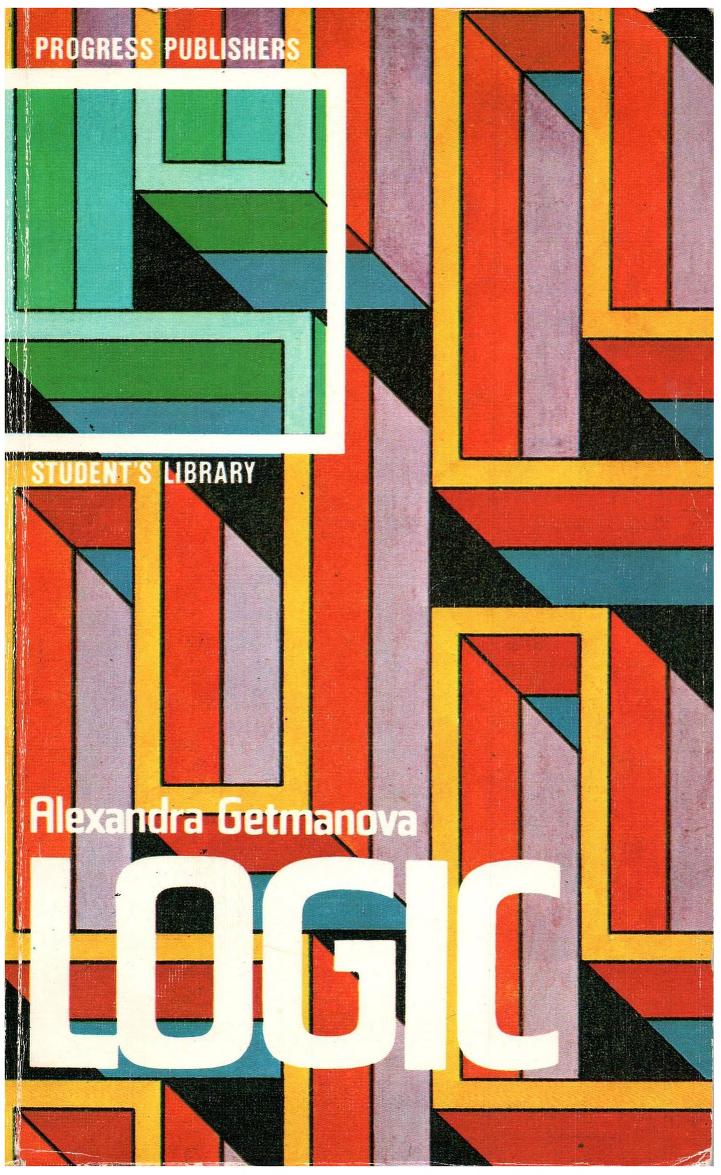
Logic (Student’s Library) by Alexandra Getmanova

In this post, we will see the book Logic (Student’s Library) by Alexandra Getmanova.


About the book

Apart from the main forms of correct thought -concepts,
judgements, inferences- this book also covers
methods of demonstration and refutation, some of the
many types of logical errors encountered in thinking,
various forms of hypotheses, etc. The symbols of
mathematical logic are used in some sections. In the last
chapter, readers will be acquainted with the history of
the development of classical logic and the main trends in
present-day symbolic logic.
This book is designed to help readers develop a
disciplined way of thinking. And an ability to think
creatively is a skill required by everyone.

Translated from the Russian Ьу Stephen Smith

The book was translated from Russian by was published in 1989 by Progress Publishers.
Credits to original uploader.

You can get the book here.
Follow us on The Internet Archive: https://archive.org/details/@mirtitles
Follow Us On Twitter: https://twitter.com/MirTitles
Write to us: mirtitles@gmail.com
Fork us at GitLab: https://gitlab.com/mirtitles/
Add new entries to the detailed book catalog here.

Posted in books | Tagged , , , , , , , , | Leave a comment