Lobachevsky And His Contributions To Science (Men of Russian Science) by V. Kagan

In this post, we will see the book Lobachevsky And His Contributions To Science (Men of Russian Science) by V. Kagan.

About the book

 In 1942 people in many countries marked the 150th anniversary of the birth of Nikolai Ivanovich Lobachevsky,1the great Russian scientist, founder of non-Euclidean geometry. This is a completely new science and although built on the old, classical geometry, the latter is no more than a cornerstone in its foundation. Lobachevsky’s ideas brought about a serious evolution in many aspects of geometry which prior to this seemed basically a science that had stopped completely in its ancient Hellenic forms. Before Lobachevsky the elements of geometry were regarded by many thinkers as some­ thing inherent, as something eternal or at any rate part of our consciousness and the only possible and necessa­ry forms of our thinking, that is as something indestruclible and unchangeable, as an eternal, God’s truth. Lo­bachevsky’s work destroyed this idealistic concept. His Ideas made ia deep imprint on all the elements and forms of mathematical construction; they came to be the guiding principles in all branches of exact knowledge— mechanics, physics and astronomy; they became very important, and in certain spheres the decisive element in philosophy. Clifford, a British mathematician, called Lobachevsky the Copernicus of geometry, comparing the great geometer with the founder of the modern heliocentric system of the Universe.
In the history of mathematics, in the history of knowl­edge and philosophy Lobachevsky, along with Archime­des, Galileo, Copernicus and Newton, will always rank among the founders of these sciences.A scientific biography of great Russian mathematician N. Lobachevsky.
Contains a list of his works and works on his life and work.

Many thanks to @hawakajhonka for making the books available.

The book was translated from Russian by was published in 1959 by Foreign Languages Publishing House
You can get the book here.

Follow us on The Internet Archive: https://archive.org/details/@mirtitles
Follow Us On Twitter: https://twitter.com/MirTitles
Write to us: mirtitles@gmail.com
Fork us at GitLab: https://gitlab.com/mirtitles/
Add new entries to the detailed book catalog here.


Posted in books | Tagged , | Leave a comment

Physics Of Interstellar Space ( A Popular Science Outline) by S. Pikelner

In this post, we will see the book Physics Of Interstellar Space ( A Popular Science Outline) by S. Pikelner.

About the book

A book covering basic aspects of interstellar matter its physical processes and interpretation. The observational evidence in the form light and its decipherment using spectrograph are discussed in detail. A book describing various astrophysical processes that occur in interstellar medium.

Many thanks to @hawakajhonka for making the books available.

Russian Text Edited by Academician V. G. Fesenkov
Translated from the Russian By Mary Zirin

The book was translated from Russian by was published in 1963 by Foreign Languages Publishing House.

You can get the book here.
Follow us on The Internet Archive: https://archive.org/details/@mirtitles
Follow Us On Twitter: https://twitter.com/MirTitles
Write to us: mirtitles@gmail.com
Fork us at GitLab: https://gitlab.com/mirtitles/
Add new entries to the detailed book catalog here.

CONTENTS

INTRODUCTION
Chapter One. PLANETARY NEBULAE 22
1. Stars and the Galaxy 5
2. The Atom and Its Properties 14
3. Instruments for the Study of Nebulae 23
4. The Results of Spectral Observations 26
5. Hydrogen Radiation .33
6. Radiation in Forbidden Lines .43
7. Methods of Determining the Temperature of Nebulae 46
8. Determining the Chemical Composition of Nebulae 50
9. The Continuous Spectrum of Nebulae 52
10. Thermal Balance and the Temperature of Planetary Nebulae 55
11. The Dynamics and Evolution of Planetary Nebulae 59
 Chapter Two. DIFFUSE NEBULAE .
12. The Temperature of Diffuse Nebulae .70
13. The Mass of Diffuse Nebulae 71
14. The Presence of Dust in Nebulae. The Relationship
of Stars and Nebulae .75
15. The Relation Between Emission and Reflection Nebulae 77
16. The Distribution of Nebulae in the Galaxy 82
Chapter Three. INTERSTELLAR GAS 85
17. Interstellar Absorption Lines .85
18. Ionisation of
Interstellar Hydrogen . 89 19. The Temperature of Interstellar Gas 94
20. Radio-Emission of Interstellar Gas 101
21. Hydrogen Radio-Emission in the 21-cm Line .107
22. The Distribution of Hydrogen in the Galaxy 112
23. The Temperature of Neutral Hydrogen 117
24. Interstellar Dust .121
25. The Dynamics of Interstellar Gas and Nebulae 133
26. The Formation of Hot Stars and Gas Acceleration 139
Chapter Four. MAGNETIC FIELDS IN THE GALAXY 152
27. Theoretical Premises 152
28. Cosmic Rays 159
29. Non-thermal Galactic Radio-Emission 162
30.Individual Radio-Emission Sources and Non-thermal Emission in the Optical Region .165
31. The Regular Field in Spiral Arms 182
32. The Spherical Subsystem of Rarefied Gas .194
Chapter Five. THE INTERSTELLAR MEDIUM: A STEP IN THE EVOLUTION OF GALACTIC MATTER 200
33. Stellar Evolution 200
34. Evolution of Galaxies .213
Posted in books | Tagged , , , , , , , , , , , , , , , , | Leave a comment

Introduction To Plasma Physics by B. M. Smirnov

In this post, we will see the book Introduction To Plasma Physics by B. M. Smirnov.

About the book

This book is based on a series of lectures delivered by the author over a ten year period at the Moscow Power-Engineer­ ing Institute to technology and chemistry undergraduates not specializing in physics. The book aims at providing a concise yet general description of the physics of weakly ionized plasma so that a budding engineer or chemist can obtain a general understanding of the phenomena occurring in the plasma of a laboratory setting. This understanding is necessary since low-temperature plasma is increasingly used in technology.
The character of the book’s intended readership demands that the mathematics of the book be relatively unsophisticat­ ed. The author believes that the purpose of this book cannot be achieved merely by including descriptive material and formulas without derivation. This approach can hardly contribute to understanding the subject since the student cannot see all the conditions providing for the validity of the result. We use another approach. The book extensively employs various evaluative techniques, which show the dependence of the result on the parameters of the problem and give its value within order of magnitude. Moreover, for some functions only their limiting values are determined or simple assumptions are made to find these functions. These methods yield a correct qualitative picture of the subject and considerably simplify the discussion. However, the simplicity of discussion is essentially thought-provoking and creates a profound understanding of the subject.
The amount of the material used in the book and the form of its presentation were chosen to provide engineering stu­ dents with the general knowledge of the fundamentals of the plasma physics, which they will need when working with plasma-containing systems.

The reader is assumed to know the material given in a basic course of general college physics. The choice of prob­lems and their treatment in the book were to some extent prompted by the author’s experience in the applied plasma research.

A list of literature for further reading is given at the end of the book.

First published 1977
Revised from the 1975 Russian edition

Many thanks to @hawakajhonka for making the books available.

The book was translated from Russian by Oleg Glebovwas published in 1977 by Mir Publishers.
You can get the book here.
Follow us on The Internet Archive: https://archive.org/details/@mirtitles
Follow Us On Twitter: https://twitter.com/MirTitles
Write to us: mirtitles@gmail.com
Fork us at GitLab: https://gitlab.com/mirtitles/
Add new entries to the detailed book catalog here.


 Contents

1 Plasma in Nature and in Laboratory Systems
What is plasma? Laboratory equipment for maintaining plasma. Space plasma.
2 Statistics of Weakly Ionized Gas
Distribution of particles by state. The Boltzmann distri­ bution. The statistical weight of a state and the distribu­ tion of particles in a gas. The Maxwell distribution. The Saha distribution. Dissociation equilibrium in the mole­ cular gas. Planck’s distribution. The laws of black body radiation.
3 The Ideal Plasma
The ideality of a plasma. Charged particles in a gas. Screen­ ing of charge and field in a plasma. Oscillations of plasma electrons. The skin effect.
4 Elementary Processes in Plasma
Act of collision of particles in a plasma. Elastic collision of particles. The total cross section of scattering and the cross section of capture. The condition of gaseousness and the ideality of plasma. The types of elementary processes. Inelastic collisions of atomic particles. Charge exchange and similar processes.
5 Formation and Decomposition of Charged Particles in Weakly Ionized Gas
Ionization of an atom in a single collision with an electron. Recombination of pairs of positive and negative ions. Triple processes. Thomson’s theory for the constant of the triple process. Triple recombination of electrons and ions. Triple recombination of the positive and negative ions. Processes involving formation of a long-lived complex. Dissociative recombination of an electron and a molecular ion. Ioniza­tion processes in collisions between an atom in an excited state and an atom in the ground state. Stepwise ionization of atoms. Thermodynamic equilibrium conditions for ex- cited atoms.
6 Physical Kinetics of Gas and Plasma
The kinetic equation. Macroscopic equations for a gas. The equation of state for a gas.
7 Transport Phenomena in Weakly Ionized Gas
Transport phenomena in gas and plasma. Transport of par­ ticles in a gas. Energy and momentum transport in a gas. Thermal conductivity due to the internal degrees of freedom. The mobility of particles. The Einstein relation. The Navier-Stokes equation. The equation of heat transport. The diffusion motion of particles. Convective instability of a gas. Convective motion of a gas. Convective heat transport. The instability of convective motion.
8 Transport of Charged Particles in Weakly Ionized Gas 100
The mobility of charged particles. The conductivity of a weakly ionized gas. Ambipolar diffusion. The mobility of ions in a foreign gas. The mobility of ions in the parent gas. Recombination of ions in a dense gas. The recombina­tion coefficient of ions as a function of gas density.
9 Plasma in External Fields 108
The electron motion in a gas in an external field. The con­ductivity of a weakly ionized gas. The Hall effect. The cyclotron resonance. The mean electron energy. The magnetohydrodynamic equations.
10 Waves in a Plasma 119
Acoustic oscillations. Plasma oscillations. Ion sound. Magnetohydrodynamic waves. Propagation of electromagnetic waves in a plasma. Damping of plasma oscillations in a weakly ionized plasma. The interaction between plasma waves and electrons. The attenuation factor for waves in plasma. The beam-plasma instability. The Buneman instability. Hydrodynamic instabilities.
11 Radiation in Gas 138
Interaction between radiation and gas. Spontaneous and stimulated emission. Broadening of spectral lines. The Doppler broadening. Broadening due to finite lifetimes of states. Impact broadening of spectral lines. Statistical broadening theory. The cross sections of emission and absorption of photons. The absorption coefficient. The conditions of laser operation. Propagation of the resonance radiation.
12 Plasma of the Upper Atmosphere 157
The balance equations for the parameters of weakly ionized gas. The distribution of particles and temperature in the atmosphere with height. The heat balance of the earth. The elemental oxygen in the atmosphere. Charged particles in the upper atmosphere.
Appendices 168
 Bibliography 170
Index 171
Posted in books | Tagged , , , , , , , , , , | Leave a comment

Envoy Of The Stars (Academician Victor Ambartsumyan) by Ashot Arzumanyan

In this post, we will see the book Envoy Of The Stars (Academician Victor Ambartsumyan) by Ashot Arzumanyan.


About the book

 From the Author
Academician Victor Ambartsumyan, an outstanding astrophysicist, President of the Academy of Sciences of Armenia, director of the Byurakan Astrophysical Observa­ tory, has twice been awarded the title of Hero of Socialist Labour, and is winner of the USSR State Prizes.
Ambartsumyan was elected President of the International Astronomical Union, and also President of the International Council of Scientific Unions. In recognition of his services to world astronomy, thirty foreign academies, scientific societies and universities have elected him as an honorary member.
In the course of the many years of work on this book, I consulted a wide range of documentary material, studied the archives of the Academies of Sciences of Armenia and the USSR, and also those o f Leningrad University, the Pulkovo Observatory and the material collected by Amazasp Ambartsumyan, the father of Victor Ambartsumyan, as well as material from my own archives which I have been col­ lecting for more than fifty years.
I met and talked with many people who know Victor Ambartsumyan: friends from his childhood and student years, his pupils and colleagues. They were all more than willing to help me, sharing their ideas and impressions. While not mentioning them by name, the author would like to express his gratitude to them all.

Many thanks to @hawakajhonka for making the books available.

Translated from the Russian by Cynthia Carlile
Designed by Nikolai Kondrashov

Published by Progress Publishers.

You can get the book here

Follow us on The Internet Archive: https://archive.org/details/@mirtitles
Follow Us On Twitter: https://twitter.com/MirTitles
Write to us: mirtitles@gmail.com
Fork us at GitLab: https://gitlab.com/mirtitles/
Add new entries to the detailed book catalog here.
 

CONTENTS

From the Author 6
Artavazd’s Behest . 7
CHAPTER ONE
To Berkeley! . 9
The Bolts of Heaven Are Broken . 14
The Signs of the Zodiac Were Born H ere . 26
CHAPTER TWO
Troubled Celebrations 36
Father and Son 38
An Irresistible Vocation 49
Correspondence . 57
CHAPTER THREE
Alma Mater 64
The Pulkovo Heights . 85
CHAPTER FOUR
The Difficult Years . 108
The Battle of Byurakan 123
CHAPTER FIVE
Eureka! . 140
The Stars Shine Down 151
CHAPTER SIX
A Light in the Window 15,
9 Pupils About Their Teacher .163
From the Scientist’s Correspondence . 181
CHAPTER SEVEN
Earthly Concerns 190
At the Hospital 199
The Byurakan Meridian 204
Round-Table Meeting 207
Academician Ambartsumyan Takes the Floor 218
There Were Many Meetings .230
Posted in books | Tagged , , , , , , | Leave a comment

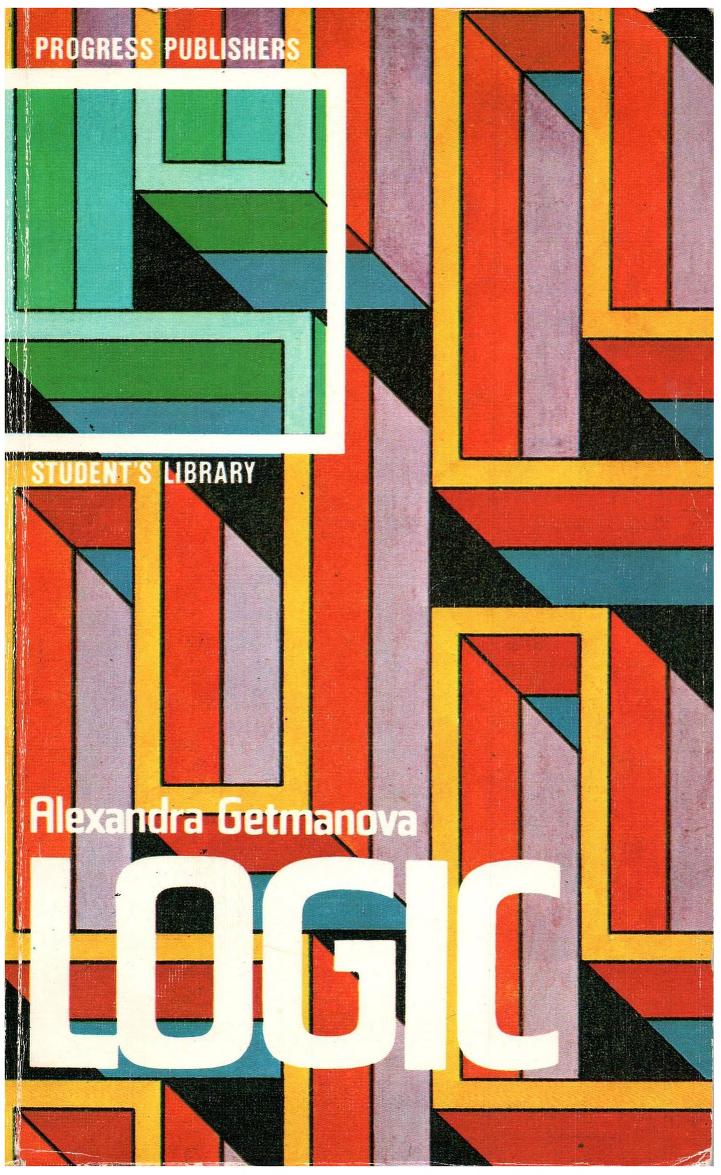
Logic (Student’s Library) by Alexandra Getmanova

In this post, we will see the book Logic (Student’s Library) by Alexandra Getmanova.


About the book

Apart from the main forms of correct thought -concepts,
judgements, inferences- this book also covers
methods of demonstration and refutation, some of the
many types of logical errors encountered in thinking,
various forms of hypotheses, etc. The symbols of
mathematical logic are used in some sections. In the last
chapter, readers will be acquainted with the history of
the development of classical logic and the main trends in
present-day symbolic logic.
This book is designed to help readers develop a
disciplined way of thinking. And an ability to think
creatively is a skill required by everyone.

Translated from the Russian Ьу Stephen Smith

The book was translated from Russian by was published in 1989 by Progress Publishers.
Credits to original uploader.

You can get the book here.
Follow us on The Internet Archive: https://archive.org/details/@mirtitles
Follow Us On Twitter: https://twitter.com/MirTitles
Write to us: mirtitles@gmail.com
Fork us at GitLab: https://gitlab.com/mirtitles/
Add new entries to the detailed book catalog here.
Posted in books | Tagged , , , , , , , , | Leave a comment

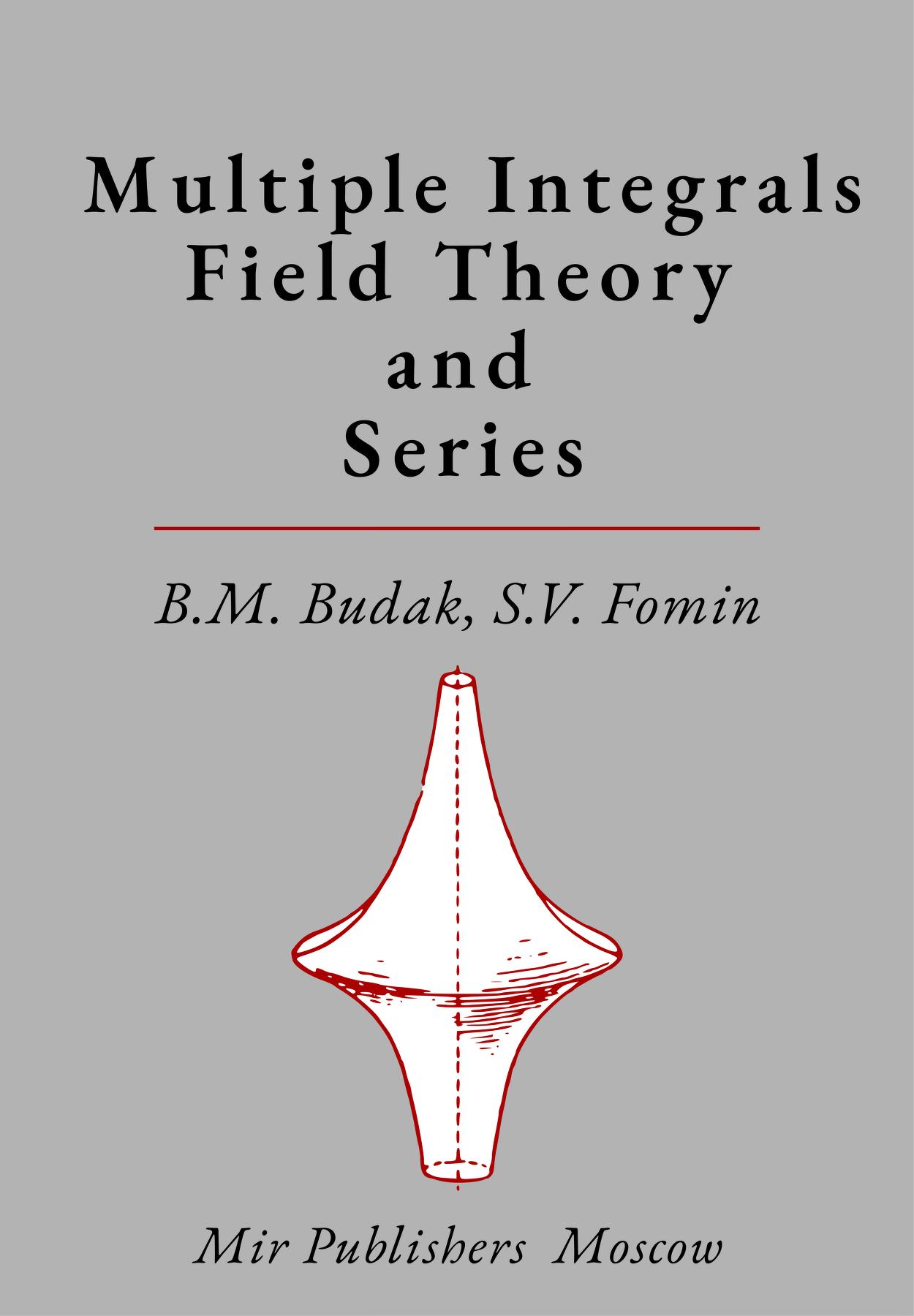
Multiple Integrals, Field Theory And Series by B. M. Budak; S. V. Fomin

In this post, we will see the book Multiple Integrals, Field Theory And Series by B. M. Budak; S. V. Fomin.

About the book

The present book is based on lectures given by the authors at the
Physical Department of the Lomonosov State University of Moscow.
In the presentation of the material much emphasis has been placed
on the physical meaning of mathematical notions and their interrelation
as well as on the applications and computational aspects.
Chapters 1-0 and Supplement 2 (On Universal Digital Computers)
have been written by S.V. Fomin and Chapters 7-11 and Supplement
1 (Asymptotic Expansions) by B.M. Budak. The authors have
discussed together the general plan of the book and many details
concerning the presentation of the material.
In the preparation of the book the authors have received valuable
advice from their colleagues V.A. Ilyin, E.G. Poznyak,
A-G- Sveshnikov and others. The authors owe very much to
A.N. Tikhonov for his helpful comments and aid- Some important
observations have been made by N.V. Yelimov and L.D. Kudryavtsev
who have read the manuscript of the book. To all of them the
authors express their warmest gratitude.

The book was translated from Russian by V. M. Volosov and was published in 1973 by Mir Publishers.

Note: the scan is poor at places, we will replace this scan with a new and clean one in some time.

Credits to original uploader.
You can get the book here.
Follow us on The Internet Archive: https://archive.org/details/@mirtitles
Follow Us On Twitter: https://twitter.com/MirTitles
Write to us: mirtitles@gmail.com
Fork us at GitLab: https://gitlab.com/mirtitles/
Add new entries to the detailed book catalog here.
 

Posted in books | Tagged , , , , , , , , , , , , | Leave a comment

Social Psychology by Galina Andreyeva

In this post, we will see the book Social Psychology by Galina Andreyeva.

About the book

Prof. Galina Mikhailovna Andreyeva,
distinguished scientist, head of the Chair
of Social Psychology at Moscow University
is the author to mure than 120 scientific
works, including textbooks, monographs
and collections under her editorship (Theoretical
and Methodological Problems of
Social Psychology, Contemporary Social
Psychology in the West, Interpersonal Perception
in the Group, Communication and
Activities, etc). Galina Andreyeva is a
member of the Central Council of the
USSR Society of Psychologists, of the
Board of the Soviet Sociological Association,
and of the European Association of
Experimental Social Psychology. Her
Social Psychology was awarded the
Lomonosov Prize in 1984.

Translated from the Russian by Thomas Dumstorf
Designed by Gennady Gubanov

Published in 1990 by Progress Publishers.
Credits to original uploader.

You can get the book here.
Follow us on The Internet Archive: https://archive.org/details/@mirtitles
Follow Us On Twitter: https://twitter.com/MirTitles
Write to us: mirtitles@gmail.com
Fork us at GitLab: https://gitlab.com/mirtitles/
Add new entries to the detailed book catalog here.
 

Posted in books | Tagged , , , , , , , , , , | Leave a comment

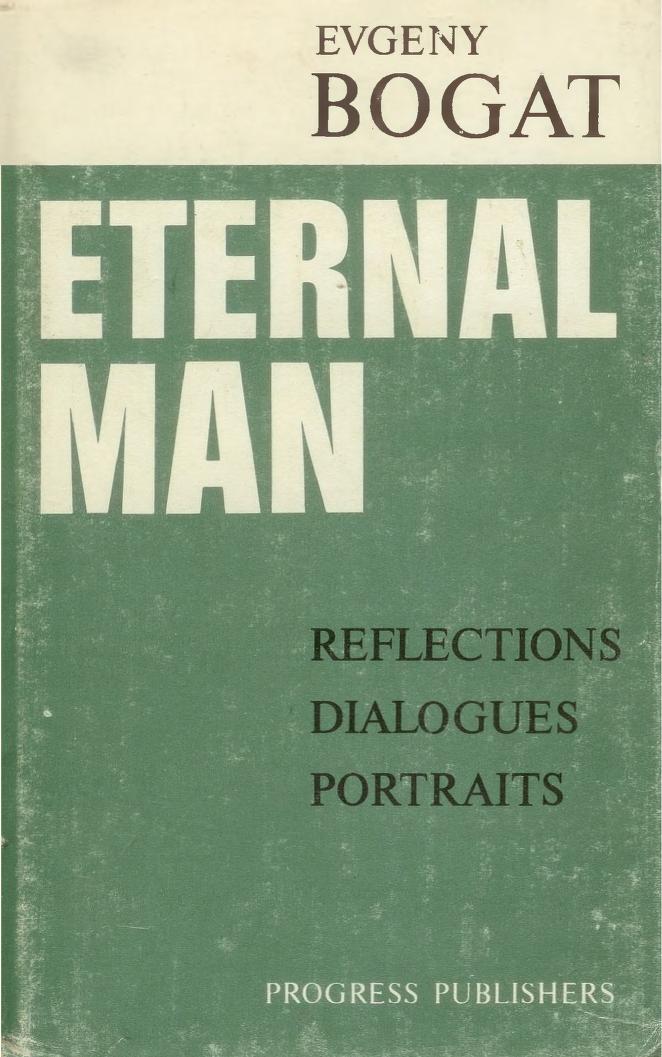
Eternal Man. Reflections, Dialogues, Portraits by Bogat Evgeny

In this post, we will see the book Eternal Man. Reflections, Dialogues, Portraits by Bogat Evgeny.

About the book

In Eternal Man, the third book of a trilogy on man’s moral world (the two preceding works—Are Wicked Sorcerors Immortal? and Wonder—will be dealt with in retrospect in Eternal Man), I have tried.to capture the spiritual life of compatriots and contemporaries.
There is a fascinating passage in Marx which states that communism is impossible unless^ the riches of the past can be preserved. This has been the inspiration for my books on the spiritual world of modern Soviet man.
The individual who remains “eternal” bears the distinct, never-to-be-repeated mark of his epoch. Eternal Man is dedicated to the eternal in man and to the spirit of the present age, to their union and at times paradoxical interpenetration.
As I worked on this book I tried to imagine the faces of future readers. The faces I saw were laughing, frowning, and expressing either amazement or alarm. As facial expressions changed I saw something I especially appreciated—the obvious look of concentration from which new thoughts arise. I admire thoughtful faces, and when they appear before me I realize that a line or paragraph has succeeded. I wish only one thing: that my readers will think along with me.
A book is a house of fantastic dimensions. One may dwell there a while and leave, but one can also stay there forever without disturbing those who settled there earlier. I wrote this book dreaming about a reader who would live on here, with me, forever.

The book was translated from Russian by Christine Bushnell was published in by Progress Publishers.
Credits to original uploader.

You can get the book here.
Follow us on The Internet Archive: https://archive.org/details/@mirtitles
Follow Us On Twitter: https://twitter.com/MirTitles
Write to us: mirtitles@gmail.com
Fork us at GitLab: https://gitlab.com/mirtitles/
Add new entries to the detailed book catalog here.

 

Posted in books | Tagged , , , , , , | Leave a comment

A History Of Afganistan by Gankovsky Yu. V. (ed.)

In this post, we will see the book A History Of Afganistan by Gankovsky Yu. V. (ed.).

About the book

A history of Afghanistan from pre-history to present times from the Soviet perspective.

Translated from the Russian by Vitaly Baskakov

Designed by Ivan Karpikov

Contributors to the book: Yu. V. Gankovsky, head of the authors’

group, M. R. Arunova, V. G. Korgun, V. M. Masson, G. A. Muradov,

G. A. Polvakov, V. A. Romodin

Published in 1985 by Progress Publishers.
Credits to original uploader.

You can get the book here.
Follow us on The Internet Archive: https://archive.org/details/@mirtitles
Follow Us On Twitter: https://twitter.com/MirTitles
Write to us: mirtitles@gmail.com
Fork us at GitLab: https://gitlab.com/mirtitles/
Add new entries to the detailed book catalog here.


Posted in books | Tagged , , , | Leave a comment

History Of Ancient Philosophy Greece And Rome by A. S. Bogomolov

In this post, we will see the book History Of Ancient Philosophy Greece And Rome by A. S. Bogomolov.

About the book

This book is primarily intended for students of the humanities,
but will also be found helpful in self-education. It consists of three parts, each serving the common purpose of providing a systematic exposition of ancient philosophers’
teachings.
Part I outlines the history of the early period of Greek philosophy.
Part I I familiarises the reader with its classical period,
Part I I I gives a brief survey of the Hellenic-Roman philosophy.
The founders of Marxism have repeatedly pointed out the
outstanding historical role of ancient culture in general and
ancient philosophy in particular. ” The Greeks will for ever remain
our teachers . . . ” ‘ ” Recent philosophy has only continued
the work begun by Heraclitus and Aristotle. “2 Marx and Engels
continually underlined the creative originality of ancient
Greek philosophy which had been the first to rise to the level
of the rational world outlook. The main fervour of its materialist
trend was invariably directed towards explaining nature
from nature itself, from the laws inherent in matter.
The historical importance of Greek philosophy also derives
from its unique contribution to the development of dialectics.
The first naive form of materialism was simultaneo,usly
a spontaneous dialectical concept of the world.
The Greeks’ own history of philosophical ideas illustrates
the profound revolutionary role of materialism. This history
which has provided classical examples of antagonism between
1 Karl Marx, ” Notebooks on Epicurean Philosophy”, in : Karl Marx,
Frederick Engels, Collected Works, Progress Publishers, Moscow, Vol. materialism and idealism clearly revealed the inevitability of
the split of all philosophers in a class society inte two big
camps. Speaking of the age-old struggle between the two
philosophical lines and underlining a class, partisan character
of the ideological battles in Greek p hilosophy Lenin asked:
“Could the struggle between materialism and idealism, the
struggle between the tendencies or lines of Plato and Democritus
in philosophy . . . have become antiquated during the two
thousand years of the development of philosophy? ” 1
Greek philosophy is a grand monument of human culture.
Its manifold forms, wrote Engels, “contain in embryo, in the
nascent state, almost all later modes of outlook on the world. “

Translated from the Russian Ьу Vladimir Stankevich
Designed Ьу Yuri Samsonov

The book was translated from Russian and was published in 1985 by Progress Publishers.
Credits to original uploader.

You can get the book here.
Follow us on The Internet Archive: https://archive.org/details/@mirtitles
Follow Us On Twitter: https://twitter.com/MirTitles
Write to us: mirtitles@gmail.com
Fork us at GitLab: https://gitlab.com/mirtitles/
Add new entries to the detailed book catalog here.


Posted in books | Tagged , , , , , , , , , , , , , , | Leave a comment