
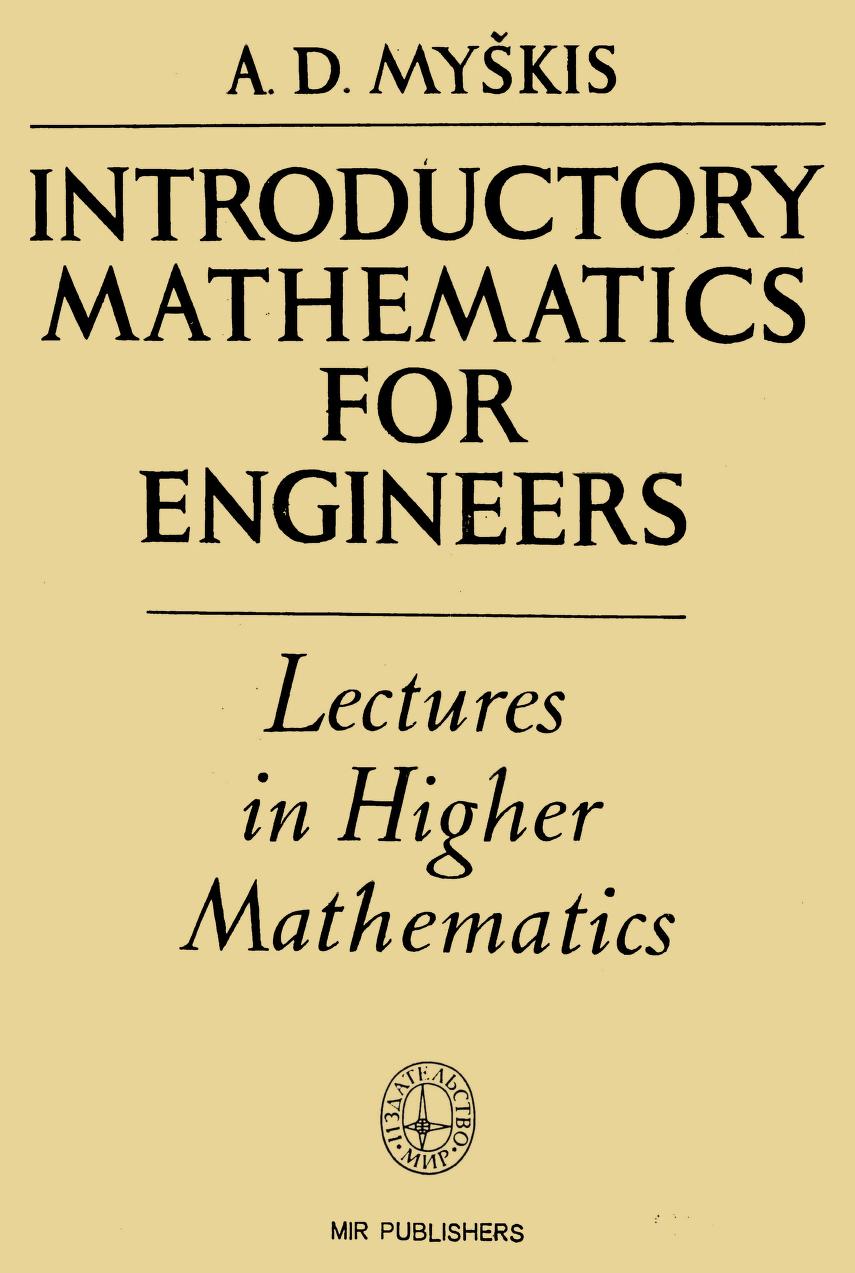
Prof. Myškis’ Lectures on Higher Mathematics is a textbook designed to cover key mathematical concepts for engineering students and technical colleges. It emphasises fundamental ideas and their practical applications in specialised fields, presented in an intuitive and accessible manner without unnecessary pedantry. The book focuses on building understanding through intuitive explanations of mathematical concepts and making their applications straightforward. It is intended for engineering students but is also suitable for home study and self-improvement.
The author, Prof. Anatoly Myškis, D.Sc., is well known not only for his original research but also for his equally original approach to the teaching of higher mathematics. He is one of the founders of the theory of differential equations with retarded argument.
His publications include Linear Differential Equations with Retarded Argument, Elements of Applied Mathematics (co-author), and Special Courses in Mathematics for Technical Colleges.
Translated from the Russian by V. M. Volosov, D. Sc.
You can get the book here and here
Follow us on
Twitter https://x.com/MirTitles
Mastadon https://mastodon.social/@mirtitles
Bluesky https://bsky.app/profile/mirtitles.bsky.social
Tumblr https://www.tumblr.com/mirtitles
Internet Archive https://archive.org/details/mir-titles
Fork us on gitlab https://gitlab.com/mirtitles
Contents
Chapter I. Variables and Functions
§ 1. Quantities
- Concept of a Quantity
- Dimensions of Quantities
- Constants and Variables
- Number Scale. Slide Rule
- Characteristics of Variables
§ 2. Approximate Values of Quantities
6. The Notion of an Approximate Value
7. Errors
8. Writing Approximate Numbers
9. Addition and Subtraction of Approximate Numbers
10. Multiplication and Division of Approximate Numbers. General Remarks
§ 3. Functions and Graphs
11. Functional Relation
12. Notation
13. Methods of Representing Functions
14. Graphs of Functions
15. The Domain of Definition of a Function
16. Characteristics of Behaviour of Functions
17. Algebraic Classification of Functions
18. Elementary Functions
19. Transforming Graphs
20. Implicit Functions
21. Inverse Functions
§ 4. Review of Basic Functions
22. Linear Function
23. Quadratic Function
24. Power Function
25. Linear-Fractional Function
26. Logarithmic Function
27. Exponential Function
28. Hyperbolic Functions
29. Trigonometric Functions
30. Empirical Formulas
Chapter II. Plane Analytic Geometry
§ 1. Plane Coordinates
- Cartesian Coordinates
- Some Simple Problems Concerning Cartesian Coordinates
- Polar Coordinates
§ 2. Curves in Plane
4. Equation of a Curve in Cartesian Coordinates
5. Equation of a Curve in Polar Coordinates
6. Parametric Representation of Curves and Functions
7. Algebraic Curves
8. Singular Cases
§ 3. First-Order and Second-Order Algebraic Curves
9. Curves of the First Order
10. Ellipse
11. Hyperbola
12. Relationship Between Ellipse, Hyperbola and Parabola
13. General Equation of a Curve of the Second Order
Chapter III. Limit. Continuity
§ 1. Infinitesimal and Infinitely Large Variables
- Infinitesimal Variables
- Properties of Infinitesimals
- Infinitely Large Variables
§ 2. Limits
4. Definition
5. Properties of Limits
6. Sum of a Numerical Series
§ 3. Comparison of Variables
7. Comparison of Infinitesimals
8. Properties of Equivalent Infinitesimals
9. Important Examples
10. Orders of Smallness
11. Comparison of Infinitely Large Variables
§ 4. Continuous and Discontinuous Functions
12. Definition of a Continuous Function
13. Points of Discontinuity
14. Properties of Continuous Functions
15. Some Applications
Chapter IV. Derivatives, Differentials, Investigation of the Behaviour of Functions
§ 1. Derivative
- Some Problems Leading to the Concept of a Derivative
- Definition of Derivative
- Geometrical Meaning of Derivative
- Basic Properties of Derivatives
- Derivatives of Basic Elementary Functions
- Determining Tangent in Polar Coordinates
§ 2. Differential
7. Physical Examples
8. Definition of Differential and Its Connection with Increment
9. Properties of Differential
10. Application of Differentials to Approximate Calculations
§ 3. Derivatives and Differentials of Higher Orders
11. Derivatives of Higher Orders
12. Higher-Order Differentials
§ 4. V. H.ospital’s Rule
13. Indeterminate Forms of the Type 0/0
14. Indeterminate Forms of the Type ∞/∞
§ 5. Taylor’s Formula and Series
15. Taylor’s Formula
16. Taylor’s Series
§ 6. Intervals of Monotonicity. Extremum
17. Sign of Derivative
18. Points of Extremum
19. The Greatest and the Least Values of a Function
§ 7. Constructing Graphs of Functions
20. Intervals of Convexity of a Graph and Points of Inflection
21. Asymptotes of a Graph
22. General Scheme for Investigating a Function and Constructing Its Graph
Chapter V. Approximating Roots of Equations. Interpolation
§ 1. Approximating Roots of Equations
- Introduction
- Cut-and-Try Method. Method of Chords. Method of Tangents
- Iterative Method
- Formula of Finite Increments
5*. Small Parameter Method
§ 2. Interpolation
6. Lagrange’s Interpolation Formula
7. Finite Differences and Their Connection with Derivatives
8. Newton’s Interpolation Formulas
9. Numerical Differentiation
Chapter VI. Determinants and Systems of Linear Algebraic Equations
§ 1. Determinants
- Definition
- Properties
- Expanding a Determinant in Minors of Its Row or Column
§ 2. Systems of Linear Algebraic Equations
4. Basic Case
5. Numerical Solution
6. Singular Case
Chapter VII. Vectors
§ 1. Linear Operations on Vectors
- Scalar and Vector Quantities
- Addition of Vectors
- Zero Vector and Subtraction of Vectors
- Multiplying a Vector by a Scalar
- Linear Combination of Vectors
§ 2. Scalar Product of Vectors
6. Projection of Vector on Axis
7. Scalar Product
8. Properties of Scalar Product
§ 3. Cartesian Coordinates in Space
9. Cartesian Coordinates in Space
10. Some Simple Problems Concerning Cartesian Coordinates
§ 4. Vector Product of Vectors
11. Orientation of Surface and Vector of Area
12. Vector Product
13. Properties of Vector Product
14*. Pseudovectors
§ 5. Products of Three Vectors
15. Triple Scalar Product
16. Triple Vector Product
§ 6. Linear Spaces
17. Concept of Linear Space
18. Examples
19. Dimension of Linear Space
20. Concept of Euclidean Space
21. Orthogonality
§ 7. Vector Functions of Scalar Argument. Curvature
22. Vector Variables
23. Vector Functions of Scalar Argument
24. Some Notions Related to the Second Derivative
25. Osculating Circle
26. Evolute and Evolvent
Chapter VIII. Complex Numbers and Functions
§ 1. Complex Numbers
- Complex Plane
- Algebraic Operations on Complex Numbers
- Conjugate Complex Numbers
- Euler’s Formula
- Logarithms of Complex Numbers
§ 2. Complex Functions of a Real Argument
6. Definition and Properties
7*. Applications to Describing Oscillations
§ 3. The Concept of a Function of a Complex Variable
8. Factorization of a Polynomial
9*. Numerical Methods of Solving Algebraic Equations
10. Decomposition of a Rational Fraction into Partial Rational Fractions
11*. Some General Remarks on Functions of a Complex Variable
Chapter IX. Functions of Several Variables
§ 1. Functions of Two Variables
- Methods of Representing
- Domain of Definition
- Linear Function
- Continuity and Discontinuity
- Implicit Functions
§ 2. Functions of Arbitrary Number of Variables
6. Methods of Representing
7. Functions of Three Arguments
8. General Case
9. Concept of Field
§ 3. Partial Derivatives and Differentials of the First Order
10. Basic Definitions
11. Total Differential
12. Derivative of Composite Function
13. Derivative of Implicit Function
§ 4. Partial Derivatives and Differentials of Higher Orders
14. Definitions
15. Equality of Mixed Derivatives
16. Total Differentials of Higher Order
Chapter X. Solid Analytic Geometry
§ 1. Space Coordinates
- Coordinate Systems in Space
2*. Degrees of Freedom
§ 2. Surfaces and Curves in Space
3. Surfaces in Space
4. Cylinders, Cones and Surfaces of Evolution
5. Curves in Space
6. Parametric Representation of Surfaces in Space. Parametric Representation of Functions of Several Variables
§ 3. Algebraic Surfaces of the First and the Second Orders
7. Algebraic Surfaces of the First Order
8. Ellipsoid
9. Hyperboloids
10. Paraboloids
11. General Review of Algebraic Surfaces of the Second Order
Chapter XI. Matrices and Their Applications
§ 1. Matrices
- Definitions
- Operations on Matrices
- Inverse Matrix
- Eigenvectors and Eigenvalues of a Matrix
- The Rank of a Matrix
§ 2. Linear Mappings
6. Linear Mapping and Its Matrix
7. Transformation of the Matrix of a Linear Mapping When the Basis Is Changed
8. The Matrix of a Mapping Relative to the Basis Consisting of Its Eigenvectors
9. Transforming Cartesian Basis
10. Symmetric Matrices
§ 3. Quadratic Forms
11. Quadratic Forms
12. Simplification of Equations of Second-Order Curves and Surfaces
§ 4. Non-Linear Mappings
13*. General Notions
14*. Non-Linear Mapping in the Small
15*. Functional Relation Between Functions
Chapter XII. Applications of Partial Derivatives
§ 1. Scalar Field
- Directional Derivative. Gradient
- Level Surfaces
- Implicit Functions of Two Independent Variables
- Plane Fields
- Envelope of One-Parameter Family of Curves
§ 2. Extremum of a Function of Several Variables
6. Taylor’s Formula for a Function of Several Variables
7. Extremum
8. The Method of Least Squares
9*. Curvature of Surfaces
10. Conditional Extremum
11. Extremum with Unilateral Constraints
12*. Numerical Solution of Systems of Equations
Chapter XIII. Indefinite Integral
§ 1. Elementary Methods of Integration
- Basic Definitions
- The Simplest Integrals
- The Simplest Properties of an Indefinite Integral
- Integration by Parts
- Integration by Change of Variable (by Substitution)
§ 2. Standard Methods of Integration
6. Integration of Rational Functions
7. Integration of Irrational Functions Involving Linear and Linear-Fractional Expressions
8. Integration of Irrational Expressions Containing Quadratic Trinomials
9. Integrals of Binomial Differentials
10. Integration of Functions Rationally Involving Trigonometric Functions
11. General Remarks
Chapter XIV. Definite Integral
§ 1. Definition and Basic Properties
- Examples Leading to the Concept of Definite Integral
- Basic Definition
- Relationship Between Definite Integral and Indefinite Integral
- Basic Properties of Definite Integral
- Integrating Inequalities
§ 2. Applications of Definite Integral
6. Two Schemes of Application
7. Differential Equations with Variables Separable
8. Computing Areas of Plane Geometric Figures
9. The Arc Length of a Curve
10. Computing Volumes of Solids
11. Computing Area of Surface of Revolution
§ 3. Numerical Integration
12. General Remarks
13. Formulas of Numerical Integration
§ 4. Improper Integrals
14. Integrals with Infinite Limits of Integration
15. Basic Properties of Integrals with Infinite Limits of Integration
16. Other Types of Improper Integral
17*. Gamma Function
18*. Beta Function
19*. Principal Value of Divergent Integral
§ 5. Integrals Dependent on Parameters
20*. Proper Integrals
21*. Improper Integrals
§ 6. Line Integrals
22. Line Integrals of the First Type
23. Line Integrals of the Second Type
24. Conditions for a Line Integral of the Second Type to Be Independent of the Path of Integration
§ 7. The Concept of Generalized Function
25*. Delta Function
26*. Application to Constructing Influence Function
27*. Other Generalized Functions
Chapter XV. Differential Equations
§ 1. General Notions
- Examples
- Basic Definitions
§ 2. First-Order Differential Equations
3. Geometric Meaning
4. Integrable Types of Equations
5*. Equation for Exponential Function
6. Integrating Exact Differential Equations
7*. Singular Points and Singular Solutions
8*. Equations Not Solved for the Derivative
9*. Method of Integration by Means of Differentiation
§ 3. Higher-Order Equations and Systems of Differential Equations
10. Higher-Order Differential Equations
11*. Connection Between Higher-Order Equations and Systems of First-Order Equations
12*. Geometric Interpretation of System of First-Order Equations
13*. First Integrals
§ 4. Linear Equations of General Form
14. Homogeneous Linear Equations
15. Non-Homogeneous Equations
16*. Boundary-Value Problems
§ 5. Linear Equations with Constant Coefficients
17. Homogeneous Equations
18. Non-Homogeneous Equations with Right-Hand Sides of Special Form
19*. Euler’s Equations
20*. Operators and the Operator Method of Solving Differential Equations
§ 6. Systems of Linear Equations
21. Systems of Linear Equations
22*. Applications to Testing Lyapunov Stability of Equilibrium State
§ 7. Approximate and Numerical Methods of Solving Differential Equations
23. Iterative Method
24*. Application of Taylor’s Series
25. Application of Power Series with Undetermined Coefficients
26*. Bessel’s Functions
27*. Small Parameter Method
28*. General Remarks on Dependence of Solutions on Parameters
29*. Methods of Minimizing Discrepancy
30*. Simplification Method
31. Euler’s Method
32. Runge-Kutta Method
33. Adams Method
34. Milne’s Method
Chapter XVI. Multiple Integrals
§ 1. Definition and Basic Properties of Multiple Integrals
- Some Examples Leading to the Notion of a Multiple Integral
- Definition of a Multiple Integral
- Basic Properties of Multiple Integrals
- Methods of Applying Multiple Integrals
- Geometric Meaning of an Integral over a Plane Region
§ 2. Two Types of Physical Quantities
6*. Basic Example. Mass and Its Density
7*. Quantities Distributed in Space
§ 3. Computing Multiple Integrals in Cartesian Coordinates
8. Integral over Rectangle
9. Integral over an Arbitrary Plane Region
10. Integral over an Arbitrary Surface
11. Integral over a Three-Dimensional Region
§ 4. Change of Variables in Multiple Integrals
12. Passing to Polar Coordinates in Plane
13. Passing to Cylindrical and Spherical Coordinates
14*. Curvilinear Coordinates in Plane
Chapter XVII. [Heading not present in the supplied contents]
§ 5. Fourier Transformation
32*. Fourier Transform
33*. Properties of Fourier Transforms
34*. Application to Oscillations of Infinite String
Chapter XVIII. Elements of the Theory of Probability
§ 1. Random Events and Their Probabilities
- Random Events
- Probability
- Basic Properties of Probabilities
- Theorem of Multiplication of Probabilities
- Theorem of Total Probability
6*. Formulas for the Probability of Hypotheses - Disregarding Low-Probability Events
§ 2. Random Variables
8. Definitions
9. Examples of Discrete Random Variables
10. Examples of Continuous Random Variables
11. Joint Distribution of Several Random Variables
12. Functions of Random Variables
§ 3. Numerical Characteristics of Random Variables
13. The Mean Value
14. Properties of the Mean Value
15. Variance
16*. Correlation
17. Characteristic Functions
§ 4. Applications of the Normal Law
18. The Normal Law as the Limiting One
19. Confidence Interval
20. Data Processing
Chapter XIX. Computers
§ 1. Two Classes of Computers
- Analogue Computers
- Digital Computers
§ 2. Programming
3. Number Systems
4. Representing Numbers in a Computer
5. Instructions
6. Examples of Programming
Appendix. Equations of Mathematical Physics
1*. Derivation of Some Equations
2*. Some Other Equations
3*. Initial and Boundary Conditions
§ 2. Method of Separation of Variables
4*. Basic Example
5*. Some Other Problems
Bibliography
Name Index
Subject Index
List of Symbols

 Mir Books