
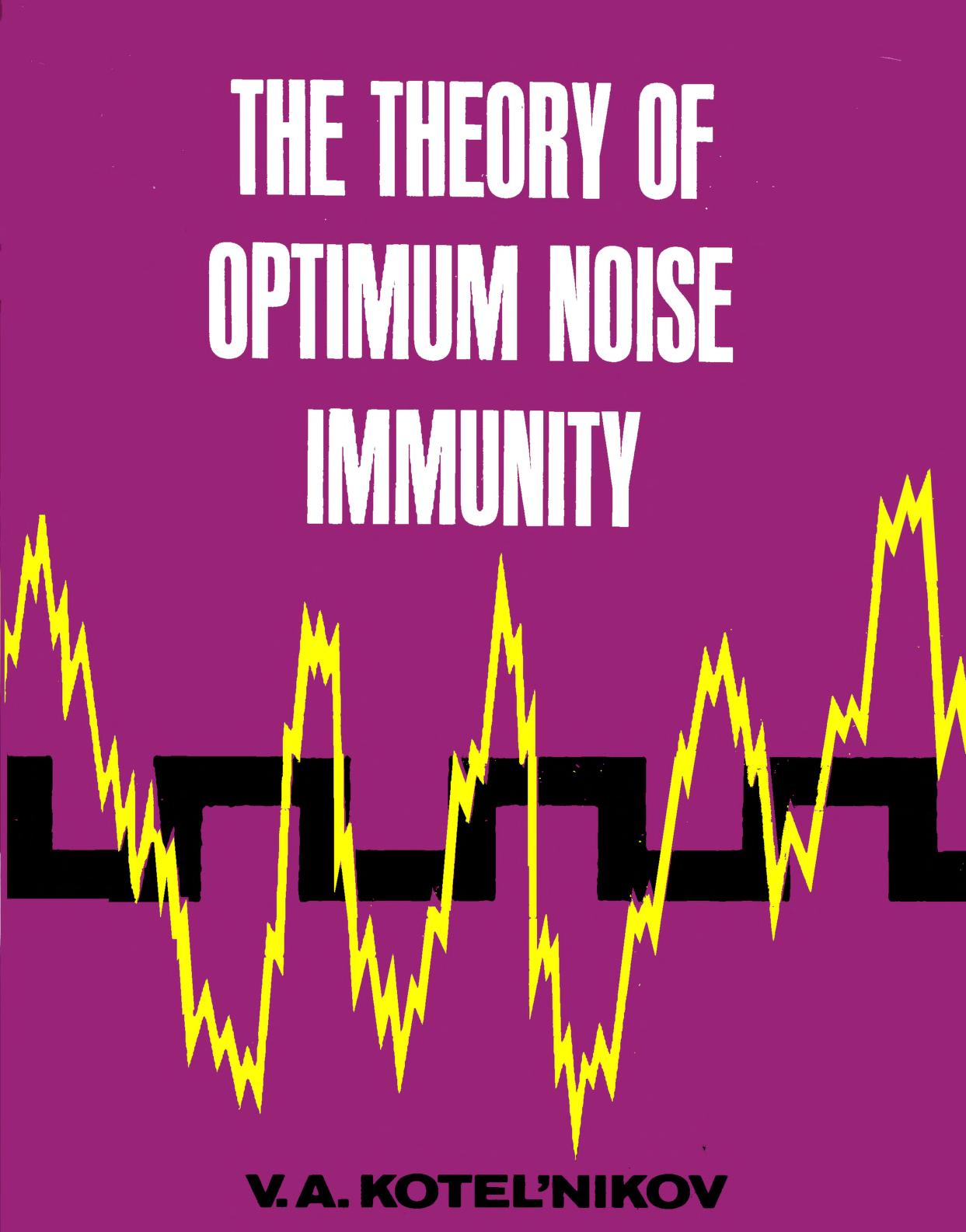
In this post, we will see the book The Theory Of Optimum Noise Immunity by V. A. Kotel’nikov.
About the book
This book is the author’s doctoral dissertation, presented in January, 1947, before the academic council of the Molotov Energy Institute in Moscow. Despite the fact that many works devoted to noise immunity have appeared in the time that has elapsed since the writing of this dissertation, not all of the topics considered in it have as yet appeared in print. Considering the great interest shown in these matters, and also the number of references made to this work in the literature, the author has deemed it appropriate to publish it, without introducing any supplementary material. However, in preparing the manuscript for publication, it was somewhat condensed, at the expense of material of secondary interest. Moreover, Chapter 2, which contains auxiliary mathematical material, has been revised somewhat, to make it easier reading, and some of the material has been relegated to the appendices.This investigation of the performance of various communications systems in the presence of additive Gaussian noise is a basic work in information theory. In it, Dr.Kotel’nikov, one of the few electronics engineers to be elected an Academician of the Academy of Sciences of the U.S.S.R., provides remarkably clear expositions of his important contributions, many of which anticipated similar developments in the West by a considerable period of time.To enable the reader to use the book more readily, the author first sets the frame work of the problems to be considered and helps the reader to sharpen his mathematical tools for the rest of the book. The second part then treats of the transmission of discrete messages, while the third and fourth parts cover transmission of a continuous parameter value and continuous time functions. Each of these parts contains examples of the application of general theory to special types of communications systems: AM, FM, PAM, PPM, SSB, and others.Idle author’s statistical analysis of his problems invokes what are now called decision theory techniques. His approach, however, is that of the practical engineer, necessitating only elementary notions of probability theory. The reader with some familiarity with Fourier series, discrete and continuous probabilities and probability densities will have little trouble in following the text. Extensive use-of geometrical models of the signalling and detection process is very helpful to the student.
Translated from the Russian by R. A. Silverman
You can get the book here.
Follow us on The Internet Archive: https://archive.org/details/@mirtitles
Follow Us On Twitter: https://twitter.com/MirTitles
Write to us: mirtitles@gmail.com
Fork us at GitLab: https://gitlab.com/mirtitles/
Add new entries to the detailed book catalog here.

 Mir Books